Investing
What a Vanguard Index Fund and Doing Absolutely Nothing Have In Common (And Why It's Made Lazy Investors Rich)
Education, not financial advice. This page may contain affiliate links: if you buy through one, Alpha Investing Group may earn a commission at no extra cost to you. How we earn money · Editorial policy
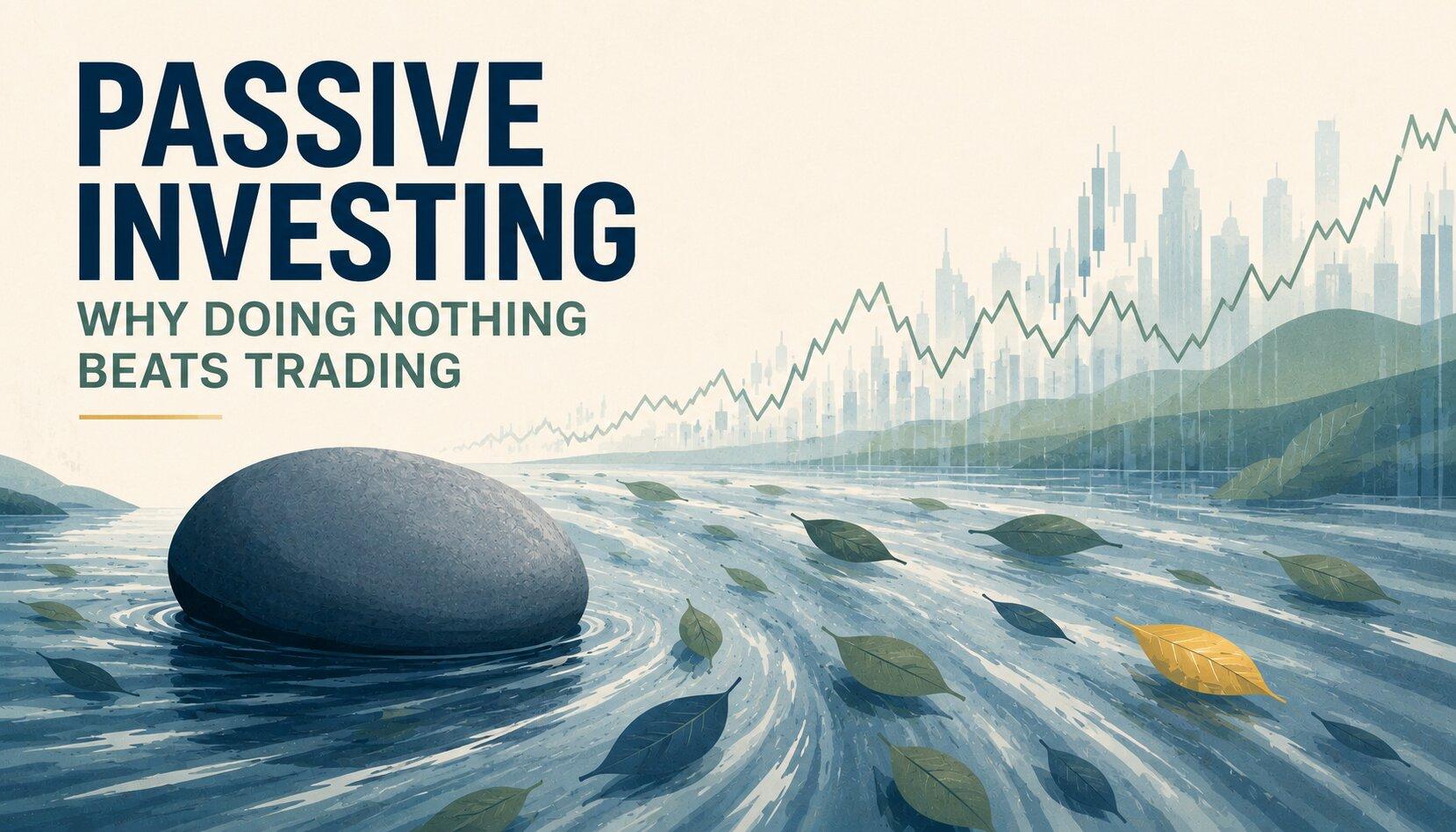
Passive index investing is the only strategy I know where the winning move is to be lazy.
You buy a fund that owns the whole market, you keep buying it, and you leave it alone. No research, no earnings calls, no thesis to defend at a dinner party. The entire skill is the absence of activity.
And it has quietly beaten most of the people who tried harder.
That should be the end of the argument.
The scoreboard has been public for twenty-five years. It is updated twice a year by the company that owns the benchmark, so the referee has no reason to flatter the winning side. Almost nobody changes what they do because of it.
Which tells you the problem was never information, and that the hard part of doing nothing is doing nothing.
Why index funds beat active funds, according to the people keeping score
The average active manager does not lose by a little. They lose by a lot, and the picture gets worse the longer you watch.
The SPIVA U.S. Scorecard for year-end 2025 found that 79% of active large-cap US equity funds underperformed the S&P 500 last year, up from 65% in 2024 and the fourth-worst showing for stock pickers in the scorecard's 25-year history. Stretch the window and the floor keeps dropping.
The longer you measure, the worse active management looks
Over 20 years, 93% of active large-cap funds did worse than the S&P 500, far more than the 50% a coin flip would give.
- Coin flip (50%)
Source: SPIVA U.S. Scorecard Year-End 2025, Report 1a (All Large-Cap Funds vs S&P 500), data as of 31 Dec 2025 · Alpha Investing Group
Show the data
| Period | Active large-cap funds that underperformed the S&P 500 |
|---|---|
| 1 year | 79% |
| 3 years | 67% |
| 5 years | 89% |
| 10 years | 86% |
| 15 years | 90% |
| 20 years | 93% |
Twenty years out, 93% of them lost. Not to a genius. To a rule that says buy everything and sort the weights by size.
The mechanism is not mysterious. The SEC's plain-English definition of a passive fund notes that "over time, higher fees and expenses can significantly lower investment returns." A fund charging an extra 0.7% in expense ratio has to beat the market by 0.7% every year just to draw level. Some managers do. Most do not, and the ones who do rarely do it twice.
Picking the winners in advance is currently worse than a coin flip.
This is the number that changed how I think about the debate. The U.S. Persistence Scorecard for year-end 2025 tracked large-cap funds that finished above the median and asked how many were still above it across the next five-year run. The answer was 4.5%. Pure chance would have produced 6.25%. Yesterday's winners are slightly less reliable than a dartboard.
Which changes what you are actually choosing between. Not index funds versus good active management, but index funds versus your ability to spot good active management before it happens, from a track record that predicts almost nothing.
Doing nothing is not the same as owning an index fund
Most write-ups of this topic stop at the fee argument. The interesting part starts after it.
Plenty of people who own index funds are not passive investors at all. They are active investors who happen to hold passive products.
Morningstar's Mind the Gap 2026 study found that over the ten years to December 2025, the average dollar invested in US mutual funds and ETFs earned 8.7% a year while those same funds returned 9.9%. Nobody charged that 1.2 percentage point shortfall. Morningstar calls it the investor return gap, and it comes entirely from when people bought and when they sold. A big part of the selling side is loss aversion: a $100 drop hurts more than a $100 gain feels good, so people bail out at exactly the wrong time.
That gap is built from four ordinary moves:
- Buying more of a fund after it has already run, because the recent numbers look reassuring
- Trimming during a drawdown, because holding feels like negligence when the screen is red
- Switching to a fund that has had a better three years, which is performance chasing wearing a sensible coat
- Sitting in cash waiting for a better entry, which is market timing even when you call it patience
None of these look reckless in the moment. Each one feels like responsible attention. That is the uncomfortable thing behavioral finance keeps turning up. The expensive behaviors do not feel like gambling. They feel like care.
So the product argument is settled and the behavior argument is where the money is. The expense ratio you pay is printed on the fund page. The cost of your own fidgeting is not printed anywhere.
The honest case against my own argument
Both of the passive camp's favorite arguments have serious people arguing the other way.
The first is the "miss the market's ten best days and your returns collapse" line, which turns up in nearly every article written in defense of buy and hold. AQR took it apart, showing it to be logically lopsided and statistically close to irrelevant, because missing the worst days helps you by a similar amount. The risks and rewards of market timing are far more symmetric than the chart in your advisor's deck suggests.
The second is the investor return gap itself. A 2026 paper in the Financial Analysts Journal, Bad Timing Does Not Cost Investors 15% of Their Funds' Returns, re-ran Morningstar's own sample and put the cost of poor timing at roughly 0.10% a year rather than 1.2%. Twelve times smaller.
I take both seriously, and the case survives, because it never rested on either. Strip out the best-days argument and the behavioral gap entirely and you are left with 93% of active funds losing over twenty years, persistence running below random chance, and a fee difference that compounds against you every year you pay it.
What Bogle's passive investing advice actually asked of you
John Bogle said "stay the course" so often that he started saying it other ways to keep people listening. One of those was "don't do something, just stand there." He also said something less quotable and more useful, recorded in the Bogle Center's transcript of his tenth principle: "The greatest enemies to the investor are expenses and emotions."
Note the order. Fees first, then feelings, treated as one category of problem. Both are leaks. One is charged to you and one you charge to yourself.
What he asked for was never easy, and calling it laziness undersells it. A doing nothing investing strategy requires four things:
- Choosing a broad, cheap fund once, and accepting that the choice is 90% of the decision and 10% of the fun
- Buying it on a schedule you set in advance, so the purchase decision is already made before the news happens
- Not opening the app during a 20% drawdown, when every instinct you have is telling you that this time is different
- Repeating that for thirty years while compounding does work that is invisible for the first decade
That is not lazy. That is a fairly demanding form of self-control dressed up as inactivity.
The strong opinion, stated plainly
The lazy investors were never lazy. They were disciplined, and discipline looks identical to laziness from the outside, which might be the luckiest accident in personal finance. It means the hardest skill in investing costs you nothing but patience. You do not have to be smart. You have to be still.
So if you own an index fund and carry a nagging feeling that you should be doing more, take this as permission to do less. The professionals paid to do more mostly cannot. Your own attempts are the leak. And the cost of a single percentage point means every extra move has to earn its keep first.
Buy the market. Keep buying. Then go do something else with the afternoon, because the afternoon is the only part of this where your effort actually pays.