Investing
Why a $100 Loss Hurts Twice as Much as a $100 Gain Feels Good (And Why It's Quietly Costing You)
This page may contain some affiliate links. This means that, at no additional cost to you, Alpha Investing Group will earn a commission if you click through and make a purchase. Learn more.
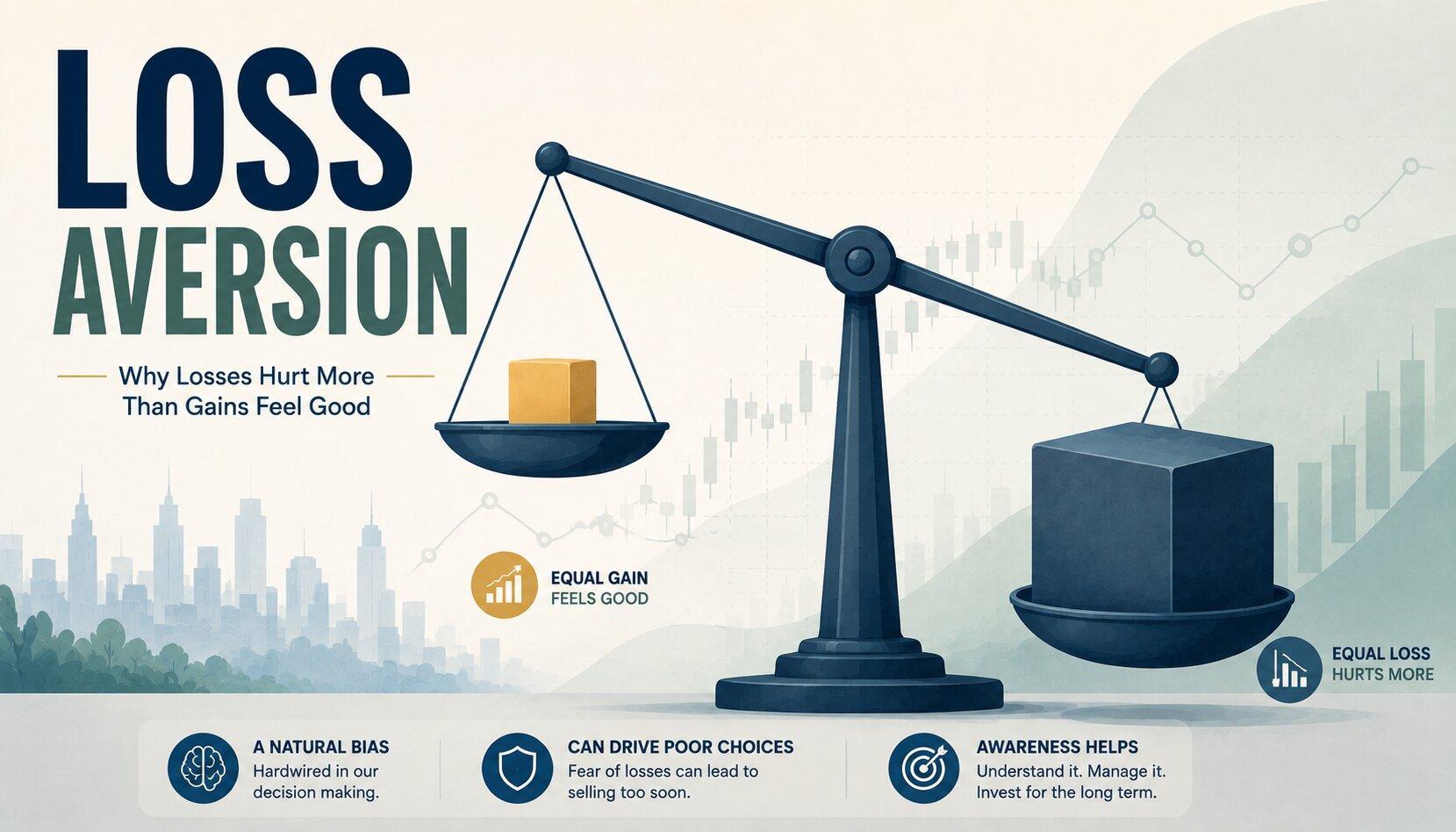
A $100 loss and a $100 gain are not the same size.
On a spreadsheet they cancel out. In your head they don't. The loss lands with about twice the force of the gain, and that lopsided math is the reason a lot of sensible people make bad calls with their money.
Psychologists have a name for it: loss aversion.
In investing, that one quirk quietly drains returns.
It talks you out of the market at the bottom. It talks you into holding your worst pick for years. It makes a perfectly good portfolio feel like a threat every time the number dips.
This piece is about loss aversion in investing: where the feeling comes from, what it costs in real dollars, and the one boring change that beats willpower.
Why we hate losses more than we like gains
Start with the number, because the number is the whole story.
Losing feels about twice as bad as winning feels good. The finding comes from Daniel Kahneman and Amos Tversky, whose 1979 paper on prospect theory showed that people value gains and losses from wherever they happen to be standing, not against their total wealth. Their value curve is "steeper for losses than for gains," in their words. Later work put a rough coefficient on it, somewhere between 1.5 and 2.5, with 2 as the number most people quote. Kahneman later won a Nobel Prize partly for this work.
Why would evolution build us this way? Because for most of human history, a bad outcome could kill you and a good one just made a decent day better. Being twice as alert to loss was a feature, not a flaw. It kept your ancestors alive.
It's a lousy setting for a 30-year investor. Markets reward people who can sit still through pain, and your wiring is screaming at you to do the opposite. This is one of the clearest examples of a behavioral bias working against the very goal you set for yourself, and it sits underneath a lot of the psychology behind money more broadly.
How loss aversion affects your investment decisions
The bias doesn't announce itself. It shows up as three decisions that each feel reasonable in the moment.
It makes you sell at the worst possible time. The market drops 20%, the account is a sea of red, and every instinct says stop the bleeding. So you sell. Panic selling feels like taking control, but what you've actually done is convert a paper loss into a real one and step out just before the rebound. The pain of watching the number fall overwhelms the math that says drops are temporary and recoveries are where most of the return lives.
It makes you marry your losers. Selling a loser means admitting you were wrong, and loss aversion makes that admission genuinely painful. So people hold. This tendency to hold losers and sell winners even has a name, the disposition effect, and it's not a lab curiosity. Terrance Odean's study of 10,000 brokerage accounts found investors sold their winners far more readily than their losers, which is exactly backward for anyone paying taxes.
It makes you too timid to hit your own targets. This one is quiet. Fear of any drop pushes people into cash and bonds that feel safe but can't grow fast enough to fund a retirement. Avoiding a small loss now locks in a bigger shortfall in 30 years.
Notice the pattern. In all three, the feeling of the loss beats the arithmetic. That's the whole mechanism, and it's the root of many of the investment mistakes investors make without ever realizing a bias was steering.
What loss aversion actually costs you
Most articles stop at "be aware of this." Almost none put a price on it. Here's the price.
Morningstar runs a study every year comparing what funds earned to what the people in those funds actually earned. The difference is pure timing, money moving in and out at the wrong moments. In the 2024 edition of that behavior-gap study, the average dollar earned 6.3% a year over the decade to the end of 2023, while the average fund earned 7.3%. That gap of about 1.1 points a year works out to roughly 15% of the return, handed back for nothing.
A point a year sounds small. Over decades it isn't. On a $100,000 portfolio left to compound for 30 years, the difference between 6.3% and 7.3% adds up to well over $200,000 by the end. That's the tax loss aversion charges, and nobody sends you the bill.
How to actually overcome loss aversion investing
Here's where I part ways with most of the advice out there. The standard fix is "know about the bias and stay disciplined." It doesn't work, and the research is blunt about why. Awareness doesn't switch the feeling off. You can understand loss aversion completely and still feel your stomach drop when the market does.
So stop trying to out-discipline your own nervous system. Change the conditions instead.
The most useful lever is how often you look. Shlomo Benartzi and Richard Thaler called this myopic loss aversion: the more frequently you check a portfolio, the more losses you see, and the more those losses spook you into acting. They found investors behave as if their time horizon is about a year, even when they're saving for a retirement decades away. The chart below shows why checking less is such a cheap win.
The less often you check, the less often you see a loss
Check every day and you'd see a loss 46% of the time; check once a year and it drops to 25%, and once a decade to just 6%.
Illustrative figures, not a forecast. Source: Illustrative, based on historical US large-cap positive-return frequencies · Alpha Investing Group
Show the data
| How often you check | Chance you see a loss |
|---|---|
| Every day | 46% |
| Every month | 37% |
| Every quarter | 31% |
| Every year | 25% |
| Every 5 years | 12% |
| Every 10 years | 6% |
Stock returns are positive far more often over long windows than short ones. Look every day and you'll see red almost half the time. Look once a year and it's about one time in four. Look on a decade horizon and a loss is rare. Same portfolio, same returns, wildly different emotional experience, purely because of when you glanced at it.
That points to a simple three-step setup that does the heavy lifting for you:
- Pre-commit in writing. Decide your target mix and your rule for market drops before one happens. A sentence like "I don't sell equities in a downturn, I rebalance" removes the in-the-moment decision, which is exactly the moment loss aversion is strongest.
- Automate the boring parts. Set up automatic contributions and automatic rebalancing. When buying and selling happen on a schedule instead of a feeling, the bias never gets a vote. Automating your money is one of the same psychological tricks that beat impulse spending, pointed at your portfolio.
- Check less often. Move from daily to quarterly, or even once a year. You're not being lazy. You're refusing to give a bias more chances to hurt you.
None of this cures loss aversion. The feeling stays. What changes is how many times a year it gets to touch your decisions, and that number is the one you can actually control.
In summary
Loss aversion is real, it's roughly a 2:1 effect, and it costs the average investor around a point of return a year through panic selling, holding losers, and hiding in cash. Knowing about it helps less than you'd hope. Building a system that checks rarely, rebalances automatically, and follows a rule you set in calm weather helps far more. You don't have to feel nothing when markets fall. You just can't let that feeling place the trades.