Investing
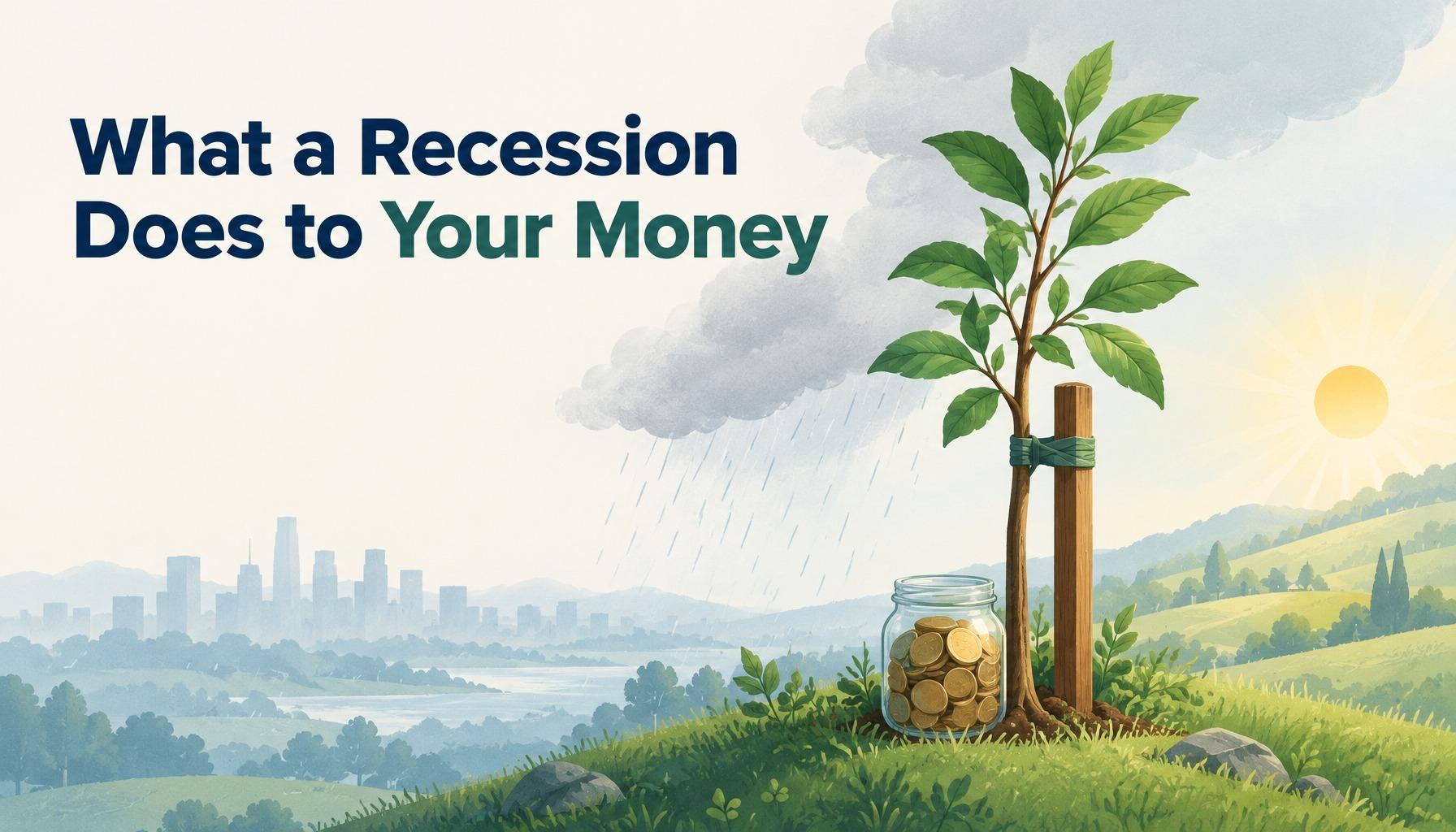
What a Recession Actually Does to Your Money in Your 20s (And the 3 Moves Worth Making Before One)
Education, not financial advice. This page may contain affiliate links: if you buy through one, Alpha Investing Group may earn a commission at no extra cost to you. How we earn money · Editorial policy
What a Recession Actually Is, and Why You Hear About It Late
A recession is not two quarters of falling GDP. That definition is everywhere, and the people who actually date recessions reject it.
In the United States, the call is made by a committee of economists at the National Bureau of Economic Research. The NBER's business cycle dating FAQ defines a recession as a significant decline in economic activity spread across the economy, lasting more than a few months, and judges it on three criteria: depth, diffusion and duration. The committee looks at payroll employment, real personal income, consumer spending, industrial production and trade sales. Sometimes a recession shows up without two consecutive quarters of falling GDP at all. The 2001 recession did exactly that.
Now the part that should change how you read the news. The committee announces a recession months after it started. The shortest gap on record was four months, for the February 2020 peak. The longest was 12 months: when the December 2007 peak was finally announced on December 1, 2008, the recession was a year old and most of the damage to hiring had already happened.
There is no siren. You live through the first year of a recession without being told you're in one, so any plan that waits for the announcement fires late every time.
The same lag works in reverse on the way out, and this is the one almost nobody mentions. Unemployment keeps climbing after the economy has already turned. After the June 2009 trough, the unemployment rate rose for another four months. After the March 1991 trough, it rose for another fifteen. Payroll employment didn't pass its previous peak until May 2014, nearly five years into a recovery that had technically been running the whole time.
So the business cycle, the job market and the stock market run on three different clocks. Markets usually turn first, hiring turns last, and the official verdict arrives somewhere in between. Nobody gets to time all three.
Your Paycheck Is the Exposure, Not Your Portfolio
Ask what a recession means for young workers and you'll get an answer about the stock market. That's the wrong organ to worry about.
Run the numbers on a typical 24-year-old. Two years of contributions at a couple of hundred dollars a month is maybe $6,000 in a 401(k). A brutal bear market takes a third of it, so $2,000 on paper, in an account you cannot touch for four decades without a penalty.
Now lose the job that pays $3,400 a month. Three months out of work costs $10,200 of income you needed. One of those losses is five times bigger, and it's the quiet one.
Unemployment risk is also not evenly distributed across ages, and this is the part the general-audience guides skip.
US unemployment rate by age, August 2026
Workers aged 20 to 24 had an unemployment rate of 7.1%, more than double the 3.1% for ages 35 to 44, in a month nobody called a recession.
Source: US Bureau of Labor Statistics, Table A-10 · Alpha Investing Group
Show the data
| Age | Unemployment rate |
|---|---|
| 16 to 19 | 14.1% |
| 20 to 24 | 7.1% |
| 25 to 34 | 4.3% |
| 35 to 44 | 3.1% |
| 45 to 54 | 3.3% |
| 55 and over | 3% |
In August 2026, the Bureau of Labor Statistics recorded an unemployment rate of 7.1% for workers aged 20 to 24, against 4.3% for 25 to 34 and 3.1% for 35 to 44. The overall rate was 4.1%. So early-career workers carry roughly double the prime-age rate in an ordinary month. Recessions don't create that gap. They widen it, because last in tends to be first out, and because the fastest way for a company to shrink is to stop hiring rather than to fire.
There's a second cost, and it lasts a lot longer than a bad year. Research by Philip Oreopoulos, Till von Wachter and Andrew Heisz, summarized by the NBER, tracked people who entered the labor market during a downturn. Their initial earnings came in about 9% below those of people who entered in good times. The gap halved within five years and took about ten years to disappear.
The mechanism wasn't unemployment. Recession entrants started at smaller, lower-paying firms, and spent years climbing back to where they would otherwise have begun.
Two details in that research matter for you specifically.
The first is that the damage was concentrated among brand-new entrants. Workers who already had two or more years of experience showed minimal losses. If you're 24 with two years behind you, you are not the most exposed person in this story, and that's worth knowing before you panic.
The second is how people recovered: by changing jobs more often than their peers. Roughly 30% of the catch-up came from that extra searching. Moving jobs repaired the damage. Sitting tight did not.
The Three Moves Worth Making Before a Recession
Most searches for how to prepare for a recession in your 20s return the same five tips in a different order. Here are three, ranked, and the ranking is the useful part: each step buys you the freedom to do the next one badly and survive.
First, Stretch the Emergency Fund Toward the Top of the Range
Every guide says three to six months. Almost none of them tells you what that is in dollars, or which end of the range applies to you.
Start from your essential monthly expenses rather than your salary or your total spending: rent, utilities, groceries, transport, insurance, phone, minimum debt payments. For our 24-year-old on $3,400 take-home, that's roughly $1,450 rent and utilities, $400 groceries, $250 transport, $200 insurance and phone, $300 minimum payments. Call it $2,600.
That makes $3,000 in savings about 1.2 months of runway. Three months is $7,800. Six months is $15,600.
Months of essential expenses covered, by how much you save each month
Starting from $3,000 against $2,600 of monthly essentials, saving $500 a month reaches three months of cover in 10 months and six months in just over two years.
- $300 a month
- $500 a month
- $700 a month
- Three months
Illustrative figures, not a forecast. Alpha Investing Group
Show the data
| Months of saving | $300 a month | $500 a month | $700 a month |
|---|---|---|---|
| 0 | 1.2 | 1.2 | 1.2 |
| 1 | 1.3 | 1.4 | 1.4 |
| 2 | 1.4 | 1.5 | 1.7 |
| 3 | 1.5 | 1.7 | 2 |
| 4 | 1.6 | 1.9 | 2.2 |
| 5 | 1.7 | 2.1 | 2.5 |
| 6 | 1.9 | 2.3 | 2.8 |
| 7 | 2 | 2.5 | 3 |
| 8 | 2.1 | 2.7 | 3.3 |
| 9 | 2.2 | 2.9 | 3.6 |
| 10 | 2.3 | 3.1 | 3.9 |
| 11 | 2.4 | 3.3 | 4.1 |
| 12 | 2.5 | 3.5 | 4.4 |
| 13 | 2.7 | 3.7 | 4.7 |
| 14 | 2.8 | 3.9 | 4.9 |
| 15 | 2.9 | 4 | 5.2 |
| 16 | 3 | 4.2 | 5.5 |
| 17 | 3.1 | 4.4 | 5.7 |
| 18 | 3.2 | 4.6 | 6 |
| 19 | 3.4 | 4.8 | 6.3 |
| 20 | 3.5 | 5 | 6.5 |
| 21 | 3.6 | 5.2 | 6.8 |
| 22 | 3.7 | 5.4 | 7.1 |
| 23 | 3.8 | 5.6 | 7.4 |
| 24 | 3.9 | 5.8 | 7.6 |
At $500 a month, three months of runway arrives in ten months and six months of runway takes just over two years. At $300 a month you cross three months in sixteen. Those are long timelines, which is exactly why this is a before move rather than a during move.
Which end of the range? Push toward the upper end if any of these describe you:
- You're the only income in your household
- You rent in an expensive city, so your fixed costs are high relative to your pay
- You work in a cyclical industry: construction, hospitality, retail, advertising, recruitment, real estate, early-stage startups
- You're in your first three years of work, where the unemployment gap above is widest
- You're on a visa where losing a job starts a clock
Two of those and six months is the target, not three.
For sizing, the median duration of unemployment was 11.3 weeks in August 2026 according to the Bureau of Labor Statistics series tracked by the St. Louis Fed. Just under three months, in a labor market nobody is calling weak. Median also means half of unemployed people were out longer than that. In a downturn the whole distribution stretches to the right.
If it helps to know where you'd stand: the Federal Reserve's 2025 survey of household economic well-being found that 55% of adults had three months of expenses set aside, and 63% could cover a $400 emergency entirely in cash. Getting to three months puts you ahead of nearly half of American adults. Treat that as an advantage you're building rather than a chore you're behind on.
Keep the money in a high-yield savings account at an FDIC-insured bank, separate from checking, and boring on purpose. Our guide to building an emergency fund covers the mechanics of where to hold it.
Second, Make Yourself Harder to Cut
This is the move that pays best and gets the least attention, because it isn't a money move and doesn't fit a finance checklist.
When a company trims headcount it rarely conducts a fair tournament. It cuts what it can identify as removable. Removable usually means: recently hired, working on something nobody senior can name, replaceable by someone already on the team, or simply invisible to the people in the room where the list gets made. Your job security is partly about performance and substantially about legibility.
Concrete things that move you off that list:
- Attach yourself to revenue or cost. Work that is visibly tied to money coming in or money being saved survives budget meetings. Work that is tied to a nice-to-have does not.
- Become the person who knows one thing. Being the only person who understands the billing system is ugly organizational design and excellent personal insurance.
- Get your work named. If your manager cannot describe your last quarter in one sentence, you have a documentation problem, not a performance problem. Send the short monthly summary. It feels excessive and it isn't.
- Keep the outside network warm before you need it. Most jobs are found through weak ties. Weak ties go cold in about a year and are much harder to reheat when the first message you send starts with "I've just been laid off."
- Bank one real skill a year. Not a certificate. Something you have shipped and can point to.
That list is what career capital means in practice. It's the accumulated set of reasons a company keeps you and another company wants you, and it compounds in the same unglamorous way a portfolio does. The third item on it is the one I'd push hardest, because it's the one that feels like self-promotion and mostly isn't.
Remember what the Oreopoulos research found about recovery: the people who caught up were the ones who moved. So stay hireable as well as employed, because those are different projects. A resume you refresh twice a year and a network you talk to are worth more during a downturn than any portfolio adjustment you could make.
Third, Leave the Contributions Running
What happens to investments in a recession is the easy part of this question, and the first two moves are why. With cash in the bank and a job you're hard to cut from, you never have to sell at the bottom, so this becomes a decision rather than an emergency.
So: keep contributing. Through the bear market, through the headlines, through the months when the balance goes down after you put money in.
The math is on your side in a way it will never be again. At 24, your contributions dwarf your returns. A $6,000 balance falling 30% loses $1,800. Contributing $200 a month for the same year adds $2,400.
Your savings rate is doing the heavy lifting, and a falling market means every one of those contributions buys more shares than it did last year. That's dollar-cost averaging doing the thing it's supposed to do, and it only works if you don't interrupt it.
Stopping is the expensive instinct, and there's a number on it. Charles Schwab's research team found that the S&P 500 returned 11.0% annualized from 2006 to 2025, but only 6.6% for an investor who moved to cash after a drop and missed the ten best days of that period. Ten days out of roughly five thousand. The best days cluster near the worst ones, which is precisely when stepping out feels most reasonable.
You don't have to forecast the market recovery. You only have to be there for it, and staying invested is how you guarantee that. For the longer argument on why trading around downturns fails, see our piece on trend following and the case for market efficiency.
One honest caveat. If you genuinely cannot make rent and the 401(k) contribution in the same month, pause the contribution. Keep the employer match if there is one, because that's an immediate return you'll never get elsewhere. This is a cash flow decision, not a market call, and the distinction matters.
The Two Instincts That Cost the Most
Two reflexes do most of the damage here, and both feel responsible in the moment.
Cutting investing contributions to feel safer. This is the expensive one. It converts a paper loss into a permanent one by removing you from the recovery, and it usually happens when the emergency fund is already adequate. If you're pausing contributions while sitting on eight months of cash, the decision is emotional. Name it as such and then decide.
Waiting in cash to buy the dip. The mirror image, and just as costly. It requires two correct calls: when to stop buying and when to start again. Most people who go to cash are still in cash well into the next expansion, because no bottom announces itself and the news is at its worst exactly when prices are at their best. Buying the dip is not the point of any of this. Continuing to buy on schedule is.
There's a third worth naming, which is checking the balance daily. It doesn't cost money directly. It costs the composure that lets you leave the first two alone.
In Summary
A recession in your 20s is mostly a labor market event wearing a stock market costume. The plan follows from that:
- Size the emergency fund off your essential expenses, not your salary, and push toward six months if you're single-income, renting expensively, or in a cyclical industry. For a $2,600 monthly baseline, that's $15,600, and $500 a month gets you there in about two years.
- Invest in being hard to cut and easy to hire. Attach your work to revenue, make it legible to whoever writes the list, keep the network warm, and bank one real skill a year.
- Keep contributing. Your savings rate matters more than returns at this balance, a falling market buys you more shares, and missing the best ten days of two decades cut an 11.0% annualized return to 6.6%.
- Watch for the two expensive reflexes. Cutting contributions to feel safer, and waiting in cash for a bottom that never rings a bell.
- Don't wait for the announcement. It arrives four to twelve months late and tells you nothing you can act on.
Every one of these is worth doing whether or not a recession shows up, and that's the point. A plan you only execute when you're frightened is a plan you'll execute badly. If you want to follow what professionals watch while the rest of us read headlines, the top economic indicators is the place to start.