Investing
How to Start Investing With $100 a Month (Without Picking Stocks or Paying Fees)
Education, not financial advice. This page may contain affiliate links: if you buy through one, Alpha Investing Group may earn a commission at no extra cost to you. How we earn money · Editorial policy
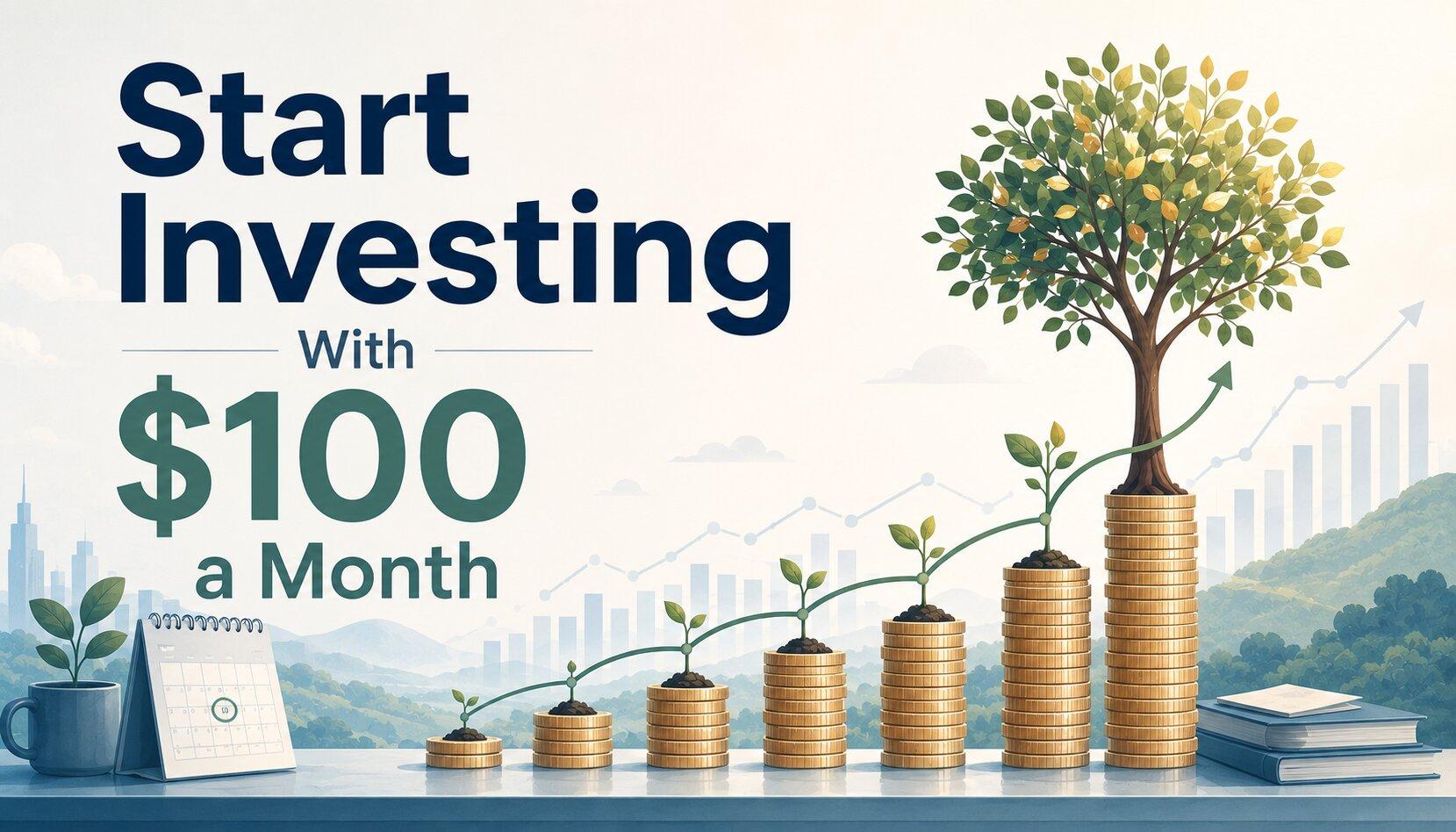
You have probably been told that investing is for people with money to spare. That is the myth this guide takes apart. You can start investing with $100 a month right now, without picking a single stock and without handing a chunk of your return to fees. The catch is not the amount. The catch is doing it in the right order and then leaving it alone.
Most guides on this topic hand you a menu of nine ways to invest $100 and wish you luck. That is the problem. A menu freezes you, and a frozen beginner does nothing.
So here is one path instead of nine options. By the end you will have:
- A clear picture of why $100 a month is enough to matter.
- The account to open first, and why.
- The single type of fund to buy, so you never pick a stock.
- The automation that makes the whole thing run without you.
- The one habit that decides whether this works over decades.
None of it asks you to become a stock picker.
Why $100 a month is enough to start
Small and consistent beats big and occasional. That is the whole idea, and the math is on your side.
When you invest, your money earns a return. The next year, that return earns its own return. Do this for long enough and the growth starts to dwarf what you actually contributed. This is compounding, and it rewards time far more than it rewards size. A 23-year-old with $100 a month has the one thing a 55-year-old with $10,000 cannot buy back, which is decades.
Here is what steady $100 monthly contributions could look like at a 7% average annual return. That rate is an illustration, not a promise, and real markets move up and down along the way.
$100 a month, growing over time (7% average annual return, illustrative)
By year 30, $36,000 of contributions has grown to about $122,000, more than three times what you put in.
- Portfolio value (7% avg, illustrative)
- Money you put in
Illustrative figures, not a forecast. Alpha Investing Group
Show the data
| Years invested | Portfolio value (7% avg, illustrative) | Money you put in |
|---|---|---|
| 0 | $0 | $0 |
| 1 | $1,239 | $1,200 |
| 2 | $2,568 | $2,400 |
| 3 | $3,993 | $3,600 |
| 4 | $5,521 | $4,800 |
| 5 | $7,159 | $6,000 |
| 6 | $8,916 | $7,200 |
| 7 | $10,800 | $8,400 |
| 8 | $12,820 | $9,600 |
| 9 | $14,986 | $10,800 |
| 10 | $17,308 | $12,000 |
| 11 | $19,799 | $13,200 |
| 12 | $22,470 | $14,400 |
| 13 | $25,333 | $15,600 |
| 14 | $28,404 | $16,800 |
| 15 | $31,696 | $18,000 |
| 16 | $35,227 | $19,200 |
| 17 | $39,013 | $20,400 |
| 18 | $43,072 | $21,600 |
| 19 | $47,425 | $22,800 |
| 20 | $52,093 | $24,000 |
| 21 | $57,098 | $25,200 |
| 22 | $62,465 | $26,400 |
| 23 | $68,219 | $27,600 |
| 24 | $74,390 | $28,800 |
| 25 | $81,007 | $30,000 |
| 26 | $88,102 | $31,200 |
| 27 | $95,711 | $32,400 |
| 28 | $103,869 | $33,600 |
| 29 | $112,617 | $34,800 |
| 30 | $121,997 | $36,000 |
| 31 | $132,056 | $37,200 |
| 32 | $142,841 | $38,400 |
| 33 | $154,406 | $39,600 |
| 34 | $166,808 | $40,800 |
| 35 | $180,105 | $42,000 |
| 36 | $194,365 | $43,200 |
| 37 | $209,654 | $44,400 |
| 38 | $226,050 | $45,600 |
| 39 | $243,630 | $46,800 |
| 40 | $262,481 | $48,000 |
Run the numbers and the gap is stark. After 10 years you would have put in $12,000 and might hold around $17,300. After 30 years you would have contributed $36,000 and might hold around $122,000. After 40 years, roughly $262,000 from $48,000 of your own money. You can reproduce these figures yourself with the SEC's compound interest calculator, which is a neutral government tool with no product to sell you. If you would rather plug in your own contribution and time horizon, our index investing calculator does the same job.
Change the return and the picture shifts, so it is worth being honest about the range. At a 5% average, 30 years of $100 a month lands near $83,000. At 9%, closer to $183,000. Nobody knows which you will get. What you can see clearly is that the money you contribute is a small fraction of the ending balance in every case, and the rest is time doing the heavy lifting.
Before you start: three boxes to tick
Investing is the right move for most people, but not the first move for everyone. Two quick checks and one setup step come first.
Run through this short list before your first $100 goes in:
- Cover a starter cash cushion. Keep a small buffer of cash for surprise bills so you are never forced to sell investments at a bad time. FINRA's guide to starting an emergency fund suggests building toward three to six months of expenses, but even a few hundred dollars set aside changes how safely you can invest. Our emergency fund guide covers how big a buffer to aim for. You do not need the full amount before you begin.
- Deal with high-interest debt. A credit card charging 22% is a guaranteed loss that beats any likely investment gain. Clear that first. Low-rate debt like a student loan can sit alongside investing.
- Confirm you can spare the $100. It should be money you will not need for years. If $100 is too tight this month, start with $25. The habit matters more than the number.
Ticked all three? Good. Now the actual plan, in four steps.
Step 1: Pick your first investment account (the beginner's order)
The account is the container. The investments go inside it. Pick the container before you pick anything else, because the tax treatment is where a good part of your long-run return comes from.
For most beginners, the order is simple. First, if your job offers a 401(k) with an employer match, contribute at least enough to get the full match. An employer match is free money, often a 50% or 100% return on what you put in before the market does anything. Nothing else on this list beats it. Second, if you have no match or you have already captured it, open a Roth IRA. You fund it with money you have already paid tax on, and qualified withdrawals in retirement come out completely tax-free, which is a strong deal when you are decades from retiring. Third, once you have room beyond that, a plain taxable brokerage account has no contribution limits and no withdrawal rules.
The limits are generous at $100 a month, so you will not bump into them. For 2026 the IRS set the IRA contribution limit at $7,500 and the 401(k) limit at $24,500. Your $100 a month is $1,200 a year, well under either cap, so a Roth IRA is plenty of room for now. If your employer offers a 401(k) too, you'll face the same Roth-or-Traditional choice there, and your tax bracket now versus in retirement is what settles it.
One practical note. Choose a brokerage with no account minimum, no monthly fee, and commission-free trades. Most of the big, well-known providers now offer exactly that. You are not looking for anything clever here, just a low-cost home for the account.
Step 2: Pick one fund, without picking stocks
Here is the part that scares people off, and here is why it should not. You are not going to pick stocks. You are going to buy the whole market in one purchase and be done.
A total market index fund holds a tiny slice of thousands of companies at once. When you buy one share, you own a sliver of the entire stock market rather than betting on any single company. That is instant diversification, and it means no research and no watching earnings calls. An index fund simply tries to match the market instead of beating it, which, boringly, is what tends to work best for regular people over long periods. A broad S&P 500 fund works the same way and is a fine choice too. If you want the full reasoning behind this, our deep dive on index investing lays it out.
Two features make this workable on $100. First, fractional shares. Most brokerages now let you buy a piece of a share, so your exact $100 goes to work even if one share costs more than that. Second, low fees. Every fund charges an expense ratio, a small yearly percentage of what you hold, and on index funds it can be close to zero.
Do not wave that fee away as too small to matter. It compounds against you the same way returns compound for you.
Same $100 a month for 30 years, three expense ratios (7% gross, illustrative)
The 1.00% fund ends about $21,000 below the 0.03% index fund, even though you put in the same $100 a month.
Illustrative figures, not a forecast. Alpha Investing Group
Show the data
| Fund | Ending balance after 30 years |
|---|---|
| 0.03% index fund | $121,277 |
| 0.50% fund | $110,618 |
| 1.00% fund | $100,452 |
The SEC's investor bulletin on fees makes the point plainly, that small ongoing fees have a large impact over time because they shrink the balance that is earning a return. In our own numbers, the same $100 a month over 30 years ends near $121,000 in a fund charging 0.03%, but near $100,000 in one charging 1.00%. Roughly $21,000 of your money, gone to fees, for holding a nearly identical basket of stocks. When two funds track the same index, the cheaper one wins by default.
So the rule is short. One broad index fund. Lowest expense ratio you can find. Our roundup of low-cost index funds is a good place to compare options. Move on.
Step 3: Automate the whole thing
Willpower is a terrible investing strategy. Automation is a great one. This is the step that does most of the work for you.
Set up a recurring transfer from your bank into your investment account, timed for the day after payday so the money leaves before you can spend it. Then set the account to automatically buy your chosen fund with that cash. Once both are on, your investing runs whether or not you think about it, which is exactly the point.
Investing the same amount every month has a name, and it is a good thing. It is called dollar-cost averaging, and as FINRA explains, it means you buy more shares when prices are low and fewer when prices are high, without ever trying to guess the right moment. Just as usefully, it takes the emotion out. You are not deciding whether today feels like a good day to invest. The schedule decides for you. If you are already in a workplace 401(k), you are doing this without noticing, because every paycheck buys in automatically. A lump sum, like a tax refund, is a different decision, and this five-step decision tree shows where it should go first.
Automation also solves the real reason beginners fail, which is not bad fund choice. It is stopping after two months.
Step 4: The behavior layer that decides everything
You have now built a small machine. The last step is learning to leave it running, because your instincts will fight you.
In year one, your returns will look boring or even negative, and that is normal. On $1,200 invested, a good year and a bad year are both worth a few dozen dollars. The balance is too small for growth to feel like anything yet. If you judge the plan by its first-year returns, you will quit right before compounding gets interesting, which for most people is a decade or two in. So do the opposite of checking constantly. Look once or twice a year, no more.
Then, when your pay rises, raise the contribution. Bumping $100 to $150 after a raise you had not been spending anyway is painless, and over a career that single habit does more than any fund you could have picked. The goal is not to get the amount perfect on day one. It is to keep the machine running and feed it a little more over time.
A worked example: your first year, month by month
Say you are 23, you have a starter cash buffer, no card debt, and $100 a month to spare. Here is what the plan actually looks like on a calendar.
| When | What you do |
|---|---|
| Week 1 | Check for a 401(k) match at work. If there is one, direct enough there first. If not, open a Roth IRA at a no-fee brokerage. |
| Week 1 | Inside the account, choose one low-cost total market or S&P 500 index fund. |
| Week 2 | Set a recurring $100 bank transfer for the day after payday, and turn on automatic investing into that fund. |
| Months 1 to 12 | Do nothing. Let the transfers and purchases run. Ignore the day-to-day balance. |
| Around month 12 | Check once. Contributions so far: $1,200. Raise the amount if your pay went up. |
That is the entire first year. Notice how little of it involves decisions after week two. You made your choices once, automated them, and spent the rest of the year not touching anything. Over the following decades, that quiet consistency is what compounding turns into a real number.
In summary
You do not need thousands of dollars, a hot stock, or a talent for timing the market. You need a small amount, the right order, and the patience to leave it alone. Here is the whole plan on one page:
- Why it works: compounding rewards time over size, so $100 a month started young can outgrow much larger amounts started late.
- Before you start: keep a small cash cushion, clear high-interest debt, and make sure the $100 is money you will not need soon.
- Step 1, the account: employer match first, then a Roth IRA, then a taxable brokerage account.
- Step 2, the fund: one broad, low-cost index fund bought with fractional shares. No stock picking.
- Step 3, automation: a recurring transfer the day after payday, set to buy automatically. That is dollar cost averaging doing its job.
- Step 4, behavior: ignore year-one returns, check twice a year at most, and raise the contribution with every pay rise.
Do those five things and the hardest part is over. The rest is just time.
This article is for educational purposes only and is not financial advice. Investment returns are not guaranteed, and figures shown are illustrative. Consider your own situation, or speak with a qualified professional, before investing.
This topic touches on personal finances, which can be stressful. If money worries are weighing on you, it can help to talk them through with someone you trust or a qualified adviser.