Investing
Save, Invest, or Pay Off Debt First? The Financial Order of Operations
Education, not financial advice. This page may contain affiliate links: if you buy through one, Alpha Investing Group may earn a commission at no extra cost to you. How we earn money · Editorial policy
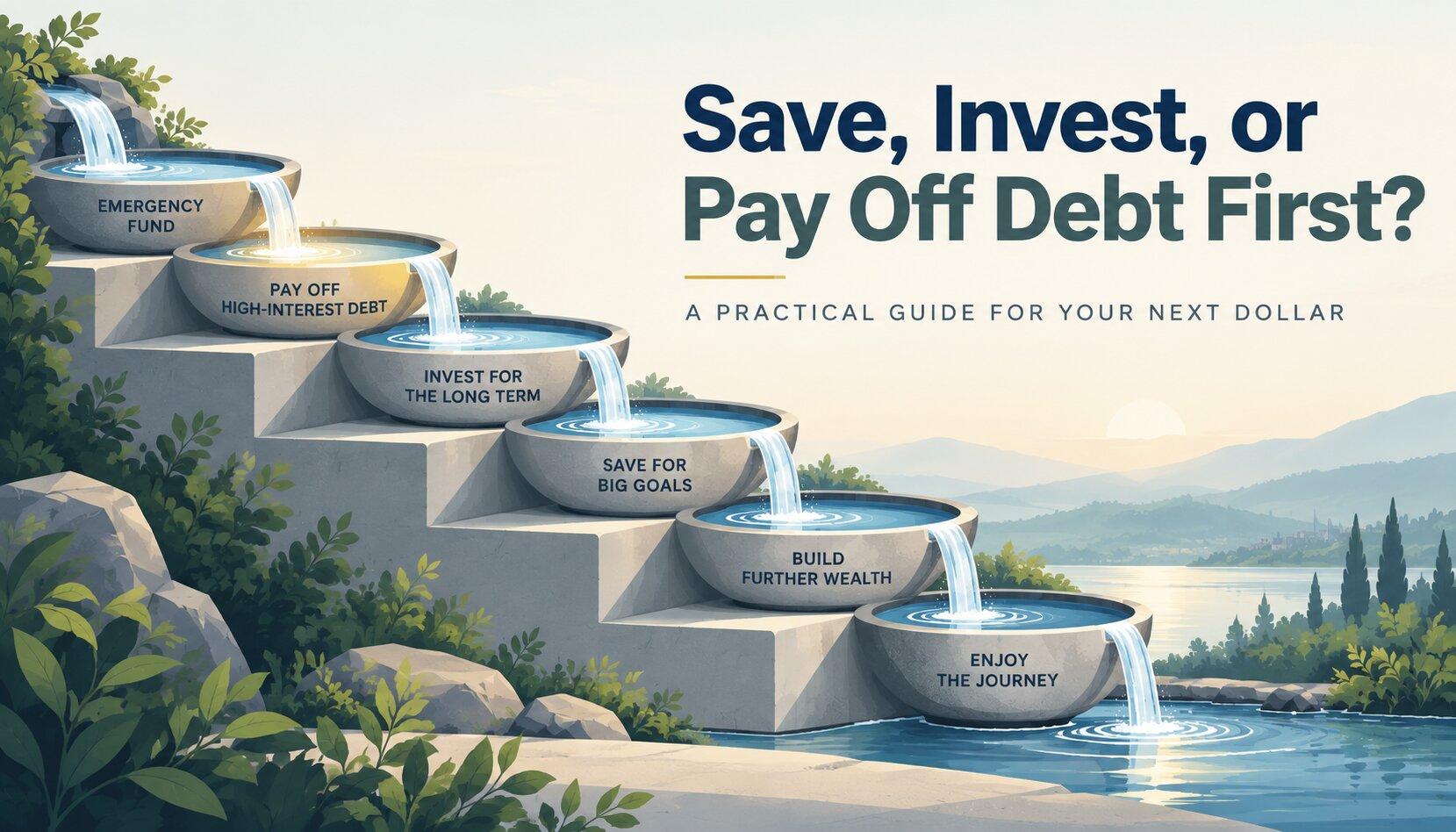
Three different guides will give you three different first steps. One says insurance deductibles. One says the employer match. One says the emergency fund. They can't all be right, and that disagreement is why so many people give up on the whole idea and go back to leaving cash in checking.
So this guide skips the part where you're handed a seventh numbered list and asked to trust it. Instead it shows you the one comparison that produces the order, so you can rebuild it yourself when your situation stops matching the template. You'll get:
- The rule that decides which step comes first, and why the popular lists disagree
- All seven steps with the actual 2026 contribution limits
- One worked example on a $55,000 salary, carried through every step
- The two situations where breaking the order is the right call
Why Nobody Agrees on Whether to Pay Off Debt or Invest First
The phrase itself belongs to somebody. Financial Order of Operations® is a registered trademark of the Money Guy brand, which built a nine-step version and did more than anyone to popularize the idea. Other versions run to seven steps, or ten. This guide uses seven. None of us is copying down a law of physics, and you should be suspicious of anyone who presents their list as if they were.
So why do they differ? Each author is quietly optimizing for something different. Some optimize purely for return on the dollar. Some optimize for the psychology of staying motivated. Some optimize for catastrophe cover, which is why one popular version opens with your insurance deductibles.
None of those is wrong. They just produce different orders.
The version below optimizes for return on your next dollar, with one correction applied for liquidity. That correction is what makes it a sequence rather than a spreadsheet sort, and it's where most of the disagreement actually lives.
The One Number That Decides Where Your Next Dollar Goes
Every dollar you haven't spent yet can go to exactly one place, and each place pays you a rate. Paying down a credit card at 22.15% buys you a guaranteed, tax-free 22.15% return. That is the same thing as an investment paying 22.15%, except nobody sells it as one. Rank the options by that rate and the order mostly builds itself.
What each dollar earns you, ranked
A 50-cent-per-dollar employer match pays 50%, more than double the 22.15% you earn by paying off a typical credit card.
Illustrative figures, not a forecast. Source: Federal Reserve G.19 (credit card rate, Q2 2026); Vanguard How America Saves 2026 · Alpha Investing Group
Show the data
| Where the next dollar goes | Return on the next dollar (% per year) |
|---|---|
| Employer 401(k) match (50c per $1) | 50% |
| Paying off a credit card (Fed G.19, Q2 2026) | 22.15% |
| Paying off a 6% student loan | 6% |
| Long-run stock market (illustrative, not promised) | 7% |
| High-yield savings (illustrative) | 4% |
The employer match sits on top by a wide margin, and it isn't close. A common formula pays 50 cents for every dollar you put in, up to some percentage of your salary. That's an instant 50% return on the money before it's been invested in anything. Vanguard's 2026 How America Saves report, which tracks around five million retirement plan participants, found the average employer match reached a record 4.7% of pay. Most people leaving money on the table aren't doing it deliberately. They just never changed the default.
Next comes high-interest debt. The Federal Reserve's consumer credit release puts the average rate on credit card accounts actually assessed interest at 22.15% in the second quarter of 2026. That's the number that matters, because it measures what people carrying a balance really pay rather than the advertised rate across all cards.
Then comes the correction. Rate of return isn't the only variable, because a dollar inside a 401(k) can't pay for a broken transmission. With no cash at all, any surprise expense goes onto the very credit card you're trying to clear, and you spend two years running in place. That's why a small cash buffer jumps the queue ahead of everything, despite earning almost nothing.
So the actual rule has two parts. Rank by return, then move enough cash to the front that you're never forced to borrow at 22% to cover a car repair. Everything below follows from those two sentences.
The 7 Steps, In Order
Step 1. Bank one month of spending in cash
Open a separate high-yield savings account and get one month of spending into it. Not one month of income, one month of spending. For most people starting out that lands somewhere between $1,500 and $3,000.
This step earns you the least and matters the most. The Federal Reserve's 2025 survey of household economic well-being found 63% of adults could cover a hypothetical $400 emergency expense with cash or its equivalent, a figure that has barely moved since 2022. If you're in the other 37%, this step is the whole game for now. Skip ahead and one flat tire undoes six months of progress.
Keep it in a separate account from your checking. Money you can see while paying for groceries is money you'll spend.
Step 2. Capture the full employer match
Log into your workplace plan and find the match formula. It will read something like "50% of the first 6% of pay" or "100% of the first 4%." Set your contribution rate to whatever captures all of it, and no higher for now. Your contribution pace against the annual limit is also one of the five numbers in our 10-minute mid-year financial review.
This is the only step in the guide where you get a guaranteed return that no market can take away. Contributing 6% of a $55,000 salary is $3,300 of your own money and, on a 50-cent formula, $1,650 of your employer's. Nothing else in this guide pays a rate like that.
Check the vesting schedule while you're in there. Employer money often becomes fully yours only after a set number of years, so leaving early can mean leaving some behind. Check the matching frequency too. If the plan matches per paycheck rather than annually, front-loading contributions early in the year can quietly cost you match you'd otherwise have got.
If your employer offers no match, skip this step and move on. You haven't done anything wrong.
Step 3. Clear every debt above roughly 8%
Now attack the expensive debt. Credit cards first, then anything else in double digits: payday loans, most personal loans, some private student loans, and a fair number of car loans.
Why 8%? That's roughly where a guaranteed return stops being obviously better than an uncertain one. Long-run stock returns have historically landed near 7% a year after inflation, but that average hides decades that were much worse, and it promises nothing about yours. Anything above about 8% guaranteed beats a maybe, and I'd rather take the sure thing than argue about it. Below 8% the argument gets genuinely close, which is why those debts turn up later.
Order your debts highest rate to lowest and pay minimums on all of them while throwing everything spare at the top one. That is the debt avalanche method, and it is mathematically the fastest route out. If you've tried it twice and stalled both times, switch to smallest balance first. A method you actually finish beats an optimal one you abandon. Our step-by-step guide to getting out of debt covers both approaches, and the credit card debt calculator will show you what each one costs in time and interest.
Step 4. Finish the emergency fund
Take that one-month buffer up to three to six months of spending.
Three months is enough if you're single with a stable job in a field that hires quickly. Six is closer to right if you have dependents or would need a long search to replace your income. Freelancers should think in terms of nine.
This money stays boring on purpose. High-yield savings, money market, short-term Treasuries. The job of this money is to be there on a Tuesday afternoon when the boiler dies. Growth is somebody else's problem. We go deeper on sizing and where to hold it in our emergency fund guide.
Step 5. Fill a Roth IRA, and an HSA if you qualify
Now the money starts working for you rather than defending you.
The IRS raised the 2026 contribution limits to $7,500 for an IRA and $24,500 for a 401(k). A Roth IRA takes money you have already paid tax on and never taxes the growth or the qualified withdrawals. That deal is unusually good when you're young and your current tax rate is probably the lowest it'll ever be. For 2026 you can contribute the full amount as a single filer until your income reaches $153,000, after which it phases out.
If you're on a high-deductible health plan, the health savings account deserves the same slot or better. An HSA is the only account that goes in untaxed, grows untaxed, and comes out untaxed for medical costs. The 2026 self-only contribution limit is $4,400. Most people treat it as a spending account, which wastes the best feature of any of the tax-advantaged accounts available to you.
One practical thing most guides skip: putting money into a Roth IRA isn't investing it. The cash just sits there until you buy something. Pick a broad, low-cost index fund and set the contribution to repeat monthly.
Step 6. Go back and max the 401(k)
With the IRA and HSA filled, return to the workplace plan and push your contribution past the match toward the $24,500 limit.
The order here is deliberate. The 401(k) came first for the match, because that was free money. It comes back later for the remaining space, because a 401(k) usually has a narrower fund menu and higher costs than an IRA you control.
If your plan offers a Roth 401(k) option, the same logic from step 5 applies to whether you use it. Our guide to tax-efficient investing walks through choosing between the pre-tax and Roth versions.
Step 7. Taxable brokerage, and the last of the cheap debt
Two things share the final step, because by now they're close enough to argue about.
One is a taxable brokerage account. No contribution limit, no early withdrawal penalty, taxed on dividends and gains. It's where money goes once the sheltered accounts are full, and it's the right home for anything you might need before 59 and a half.
The other is prepaying low-rate debt. A 3% mortgage or a 5% federal student loan isn't an emergency, and over a long horizon investing the money has historically beaten paying it down. Historically is doing real work in that sentence. Plenty of people would rather own their home outright than hold a slightly bigger portfolio, and that's a preference, not a mistake. Our comparison of paying off a mortgage early versus investing lays out both sides.
Where a $55,000 Salary Actually Lands
Abstract steps are easy. Here's what they do to an actual paycheck.
Take a 24-year-old earning $55,000, single, no dependents, in a state with modest income tax. Take-home is roughly $3,550 a month. Rent, food, transport, phone, the $250 minimum on a student loan, and normal life spending come to about $3,000. That leaves $550 a month, or $6,600 a year, which happens to be a 12% savings rate.
There is also a $3,000 credit card balance sitting at 22%.
| Stage | What happens | How long at $550/month |
|---|---|---|
| Step 1 | Build the $2,000 starter buffer | About 4 months |
| Step 2 | Switch on the 6% deferral to capture the full match | Immediately, but it costs about $215/month of take-home |
| Step 3 | Clear the $3,000 card with the remaining $335/month | About 10 months |
| Step 4 | Grow the buffer to $9,000, three months of spending | About 21 months |
| Step 5 | Open a Roth IRA and contribute $335/month, roughly $4,020 a year | Ongoing, against a $7,500 limit |
Step 2 is worth pausing on. Deferring 6% of pay is $275 a month of gross salary, but because it comes out before tax it only costs around $215 of take-home. The employer adds $137.50 a month on top. Your spendable surplus drops to roughly $335 and you're still ahead.
Then look at where this person ends up. Three and a half years in, they're at step 5, putting about $4,000 a year into a Roth IRA against a $7,500 limit. Step 6 never happens. Step 7 never happens.
How much each step can swallow on a $55,000 salary
Only the first three steps each fit inside this saver's $6,600 a year; step 6 alone could absorb $21,200, more than three times that.
Illustrative figures, not a forecast. Source: IRS IR-2025-111 (401(k) and IRA limits); Rev. Proc. 2025-19 (HSA limit) · Alpha Investing Group
Show the data
| Step | Dollars the step can absorb in a year |
|---|---|
| 1. Starter buffer | $2,000 |
| 2. Employer match | $3,300 |
| 3. High-interest debt | $3,000 |
| 4. Finish the emergency fund | $9,000 |
| 5. Roth IRA + HSA | $11,900 |
| 6. Max the 401(k) | $21,200 |
And that's fine. A 12% savings rate on $55,000 buys you the first four and a half steps, which already puts this person ahead of most of their peers. I'm showing it because almost every guide on this topic quietly implies you'll march through all seven steps, and on a normal starting salary you won't. Knowing where the sequence runs out beats pretending it doesn't.
When to Break the Order, and the One Rule That Doesn't Move
Two situations justify jumping the queue.
One is a near-term goal the sequence doesn't contain. A house deposit you need in three years belongs in cash or short-term bonds, in its own account, outside this framework entirely. The same goes for a planned career break.
The other is a debt that's quietly wrecking you. If a $900 balance is keeping you awake at 2am, clear it and move on. The rate math says it should wait, but your ability to keep going is worth more than the interest.
Step 2 is the one that never moves.
Capture the full employer match before anything except a minimal cash buffer. Not after the credit card, not after the emergency fund, not once things settle down. A 50% instant return with no market risk doesn't exist anywhere else in personal finance, and every month you skip it that money is gone for good. There's no going back for last year's match.
One more thing, plainly. These steps aren't gates. You can build the emergency fund and pay down the card at once, splitting the surplus, and for a lot of people that's the more realistic version. The order tells you where the marginal dollar goes when you're forced to choose, not what you must finish first.
In Summary
The whole framework, as a checklist:
- Bank one month of spending in a separate savings account
- Capture the full employer match, whatever your plan's formula requires
- Clear every debt above roughly 8%, highest rate first
- Finish the emergency fund at three to six months of spending
- Fill a Roth IRA, and an HSA if you are eligible, then actually invest the cash
- Max the 401(k) up to the $24,500 limit for 2026
- Taxable brokerage, or prepay the cheap debt if you would sleep better
It rests on two ideas. Rank each dollar by what it earns you, then pull enough cash forward that a surprise never pushes you back onto the credit card. When your situation changes, rebuild the order from those two ideas instead of going to look for a different list.
And if you reach step 5 and sit there for a decade, you're doing fine.