Investing
The Recency Bias That Quietly Makes Investors Buy High and Sell Low
This page may contain some affiliate links. This means that, at no additional cost to you, Alpha Investing Group will earn a commission if you click through and make a purchase. Learn more.
Your brain is not keeping score fairly.
It weights the last three months of market news far more heavily than the ten years behind them. Recent things feel like information. Older things feel like history, and history is what you skim. That's recency bias, and investing is where it costs you the most, because it's why careful people buy high and sell low while feeling perfectly reasonable the whole time.
Here's the part most of the personal finance internet won't say out loud.
The industry's favorite statistic for this bias is probably too big. Four academics took the number apart using the same data it came from and found the real cost of bad timing is a small fraction of what gets quoted. That matters, and it changes nothing about what you should do.
What follows is the honest number, and the one rule I'd adopt anyway.
How recency bias affects your portfolio returns
There are two ways to measure what a fund did. Total return assumes you bought at the start and sat there. Investor returns, sometimes called dollar-weighted returns, account for when money actually arrived and left.
The difference between them is the tax that behavior charges you.
Morningstar's Mind the Gap 2026 study put numbers on it last week. Over the decade to 31 December 2025, the average dollar in US mutual funds and ETFs earned 8.7% a year. The funds themselves returned 9.9%. That 1.2 percentage point shortfall is the investor return gap, and across the market it works out to roughly $3.8 trillion of return that existed on paper and never made it into anyone's account.
Nobody in that data set was trying to buy high and sell low. They were doing what felt sensible after reading the news, which is what makes this bias expensive rather than obvious. Money showed up after good stretches and left after bad ones. That's performance chasing, and it's the most common way the psychology behind money turns a decent portfolio into a mediocre outcome.
Does chasing past performance actually work?
No. And it isn't close.
The SEC makes funds print a warning that this year's top performers aren't necessarily next year's. Most people read that as legal boilerplate. It's a summary of what the numbers keep showing.
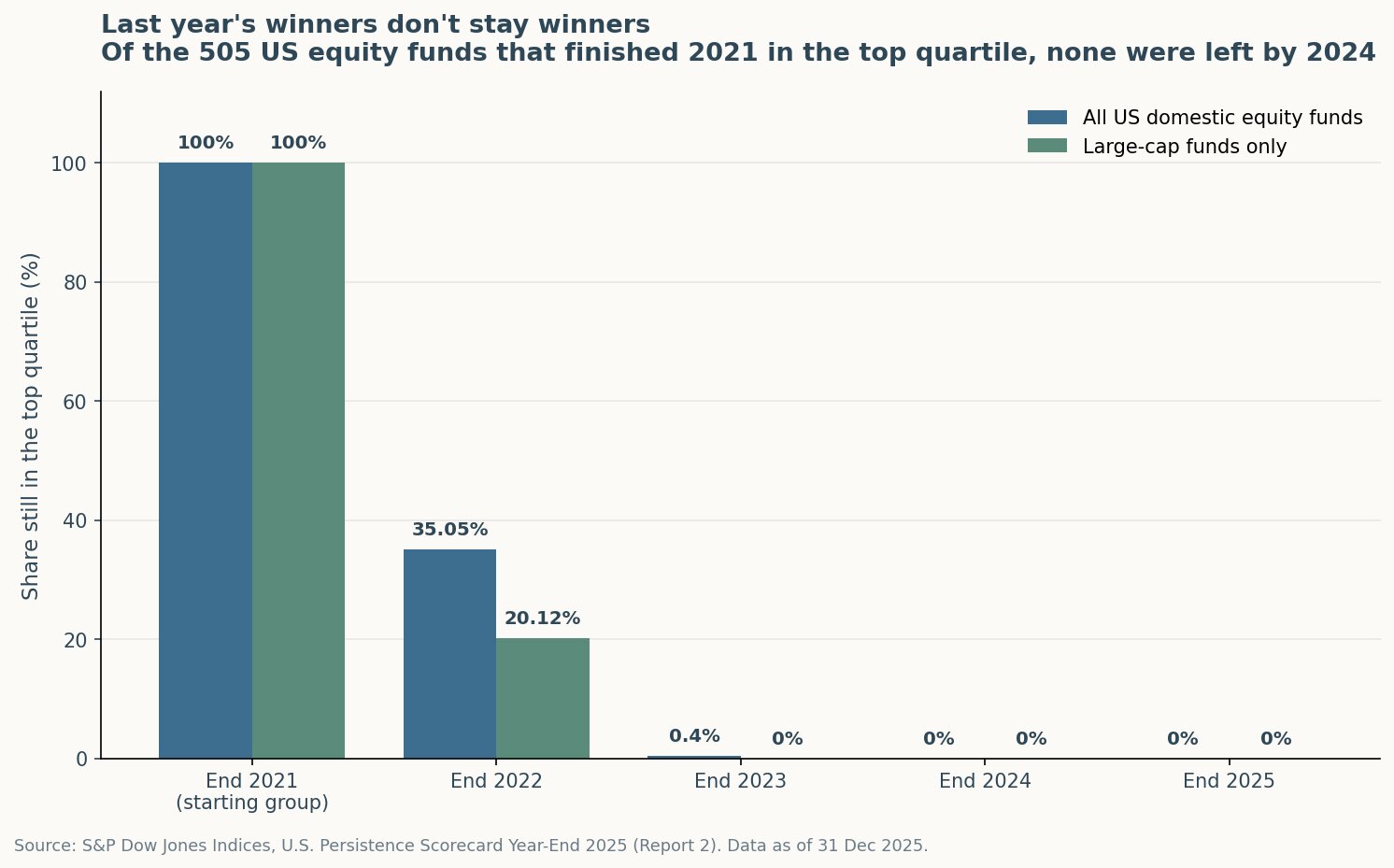
Figure 1: The share of top-quartile US equity funds from 2021 that remained in the top quartile each year through 2025, falling from 35% to zero.
The year-end 2025 US Persistence Scorecard from S&P Dow Jones Indices tracked 505 actively managed US equity funds that finished 2021 in the top quartile. A year later, 35% were still there. By the end of 2023, 0.4%. By the end of 2024, none at all. Large-cap funds got there a year sooner.
Past performance is not a weak signal here. It's close to no signal. Only 4.5% of above-median large-cap funds stayed above median across the full five years, and pure chance would have produced 6.25%. Winners revert. That's mean reversion doing ordinary work, and it's the same force that makes momentum and mean reversion so hard to trade around.
The honest version of the number
Search "recency bias investing" and you'll find a dozen pages quoting Morningstar's gap as the settled cost of investor stupidity. It probably isn't. In a paper forthcoming in the Financial Analysts Journal, four finance academics re-examined Morningstar's Mind the Gap methodology and found that on the same sample, poor timing costs fund investors 0.10% per year. Not 1.2 points. About a twelfth of it.
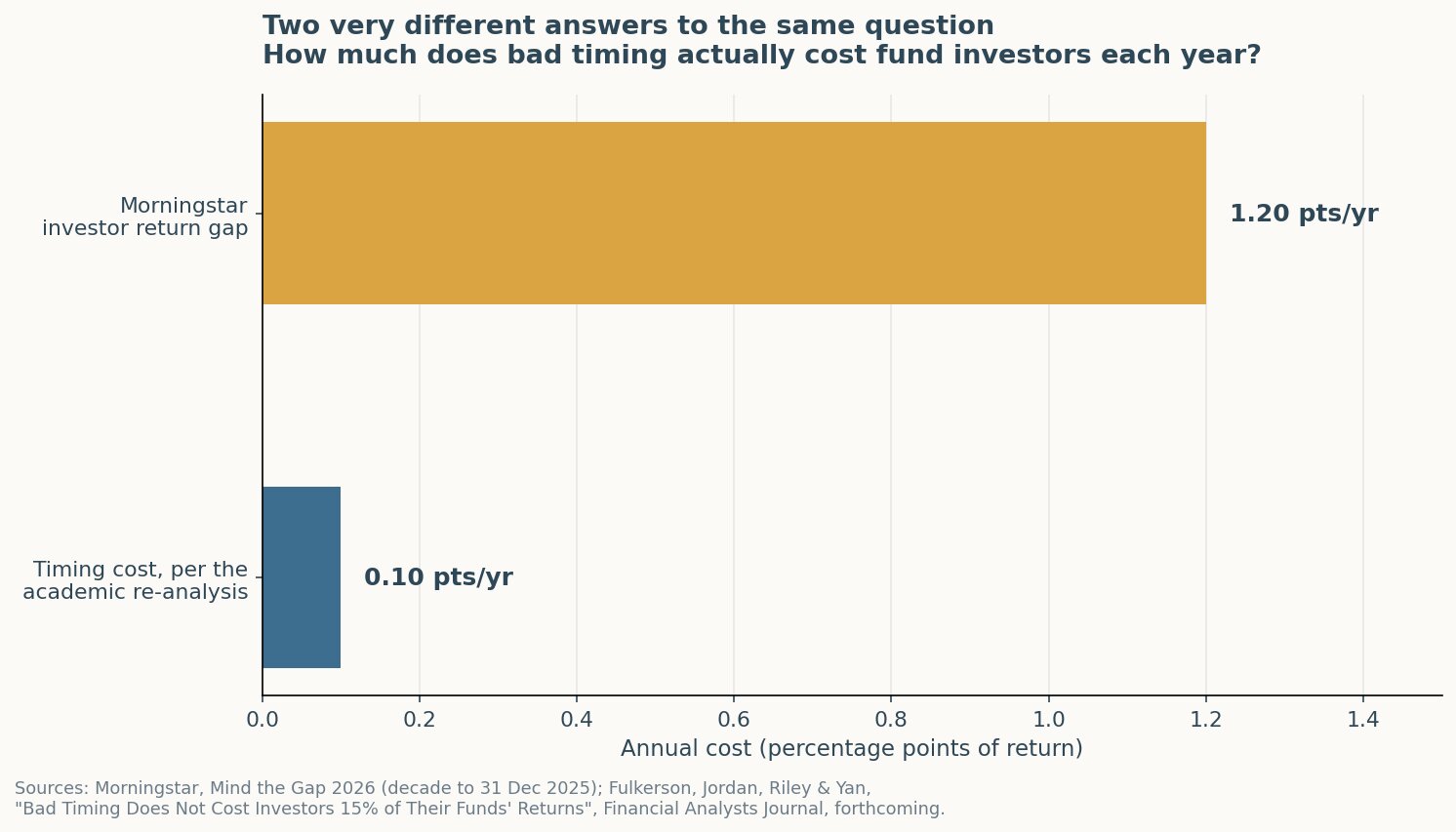
Figure 2: Comparing Morningstar's 1.2 percentage point investor return gap with the 0.10 percentage point timing cost found in the academic re-analysis.
The difference comes down to what the gap measures. It picks up any mismatch between when money was invested and how the fund performed, including plain arithmetic effects like a fund holding more assets during a weaker stretch. Calling all of that a decision is a leap.
I find this useful rather than deflating. If someone needs you to believe your own psychology is costing you 15% of your returns before you'll adopt a boring habit, the habit was never the point of the article.
Why your feed makes this worse
Recency bias needs fresh input to work on, and you have never had more of it.
The FINRA Investor Education Foundation's 2026 research on social-media-informed investors found that 61% of investors aged 18 to 34 acted on a recommendation from a social media personality, against 6% of investors over 55. That same group scored 42% on an objective investing knowledge quiz while 63% rated their own knowledge as high.
A feed is a machine for making the recent feel important. It surfaces whatever moved this week, everyone sees roughly the same thing at the same time, and herd behavior does the rest. That's the engine room of trend-following and why it's dangerous for anyone with a 30-year horizon.
How to avoid recency bias in investing
Every other article on this topic ends with six tips. Six tips is the same as no tips, because you'll remember none of them by Friday.
So here's one rule, in three parts:
- Fix the contribution. Pick an amount, automate it, and let it run through good months and bad ones without a decision. When the buying is on a schedule, recency never gets a vote.
- Review once a year. Put a date in the calendar. Rebalance to your target mix on that date and only that date. Once a year is often enough to keep your risk where you set it, and rare enough that last quarter's news has stopped feeling urgent.
- Touch nothing in between. No adding to the winner, no trimming the laggard, no "just moving a little into" whatever your feed is excited about. This is the part that costs people money, and it's one of the investment mistakes investors make most reliably.
Notice what the rule doesn't ask of you. It doesn't ask you to stay calm during a selloff, or to be smarter than anyone. It removes the moments when the bias gets to place a trade.
In summary
Recency bias is real, it's ordinary, and you have it. What's oversold is the price tag. Morningstar's investor return gap says 1.2 points a year, careful academic work on the same data says 0.10, and the truth sits in a range nobody can pin down. I'd rather tell you that than pretend otherwise. It doesn't change the answer, though. Fixed contributions and one annual review take about twenty minutes a year and protect you whether the real number is large or small. Free insurance against an uncertain loss is still worth taking. Adopt the rule, then go and think about something more interesting than your portfolio.
Frequently asked questions
How much does recency bias actually cost you?
Less than you've been told, and more than zero. Morningstar's investor return gap for the decade to December 2025 was 1.2 percentage points a year. A forthcoming Financial Analysts Journal paper re-ran the same sample and attributed only 0.10 points to genuinely poor timing, with the rest coming from arithmetic effects rather than decisions. Treat the honest answer as a range between those two numbers.
Does chasing last year's best-performing fund ever work?
Occasionally, by luck, and not in a way you can plan around. S&P's year-end 2025 persistence data followed 505 top-quartile US equity funds from 2021 and found none still in the top quartile three years later. Only small-cap funds produced survivors at all, at about 2%. Buy the winner and you're mostly buying the point where its run ends.
Should I stop checking my portfolio?
Checking isn't the problem. Acting on what you see is. If you enjoy looking, look, but separate the looking from the doing by deciding in advance that trades only happen on your annual review date. Most people find the urge to check fades once they can't act on it.
How often should I rebalance to avoid recency bias?
Once a year is plenty for most long-term investors, and picking a fixed date matters more than picking the perfect frequency. Rebalancing on a calendar date is a rule. Rebalancing when your allocation "feels off" is recency bias with a spreadsheet, because what makes it feel off is almost always whatever moved most recently.