Investing
Can You Trust AI for Financial Advice? Seven Chatbots Gave Seven Answers
This page may contain some affiliate links. This means that, at no additional cost to you, Alpha Investing Group will earn a commission if you click through and make a purchase. Learn more.
Can you trust AI for financial advice? Three researchers gave seven chatbots the same money question to find out.
A 30-year-old married couple in St. Louis, two young children, one income, a paid-off home. How much should they hold in emergency savings? Every tool got identical wording, in a fresh session, in the same week.
The answers ranged from about $21,000 to $37,500.
One chatbot told that family they were nearly done saving. Another told them they were barely two-thirds of the way there. Neither hedged, and neither had any idea the other existed.
The honest answer is sometimes, and you can predict which times.
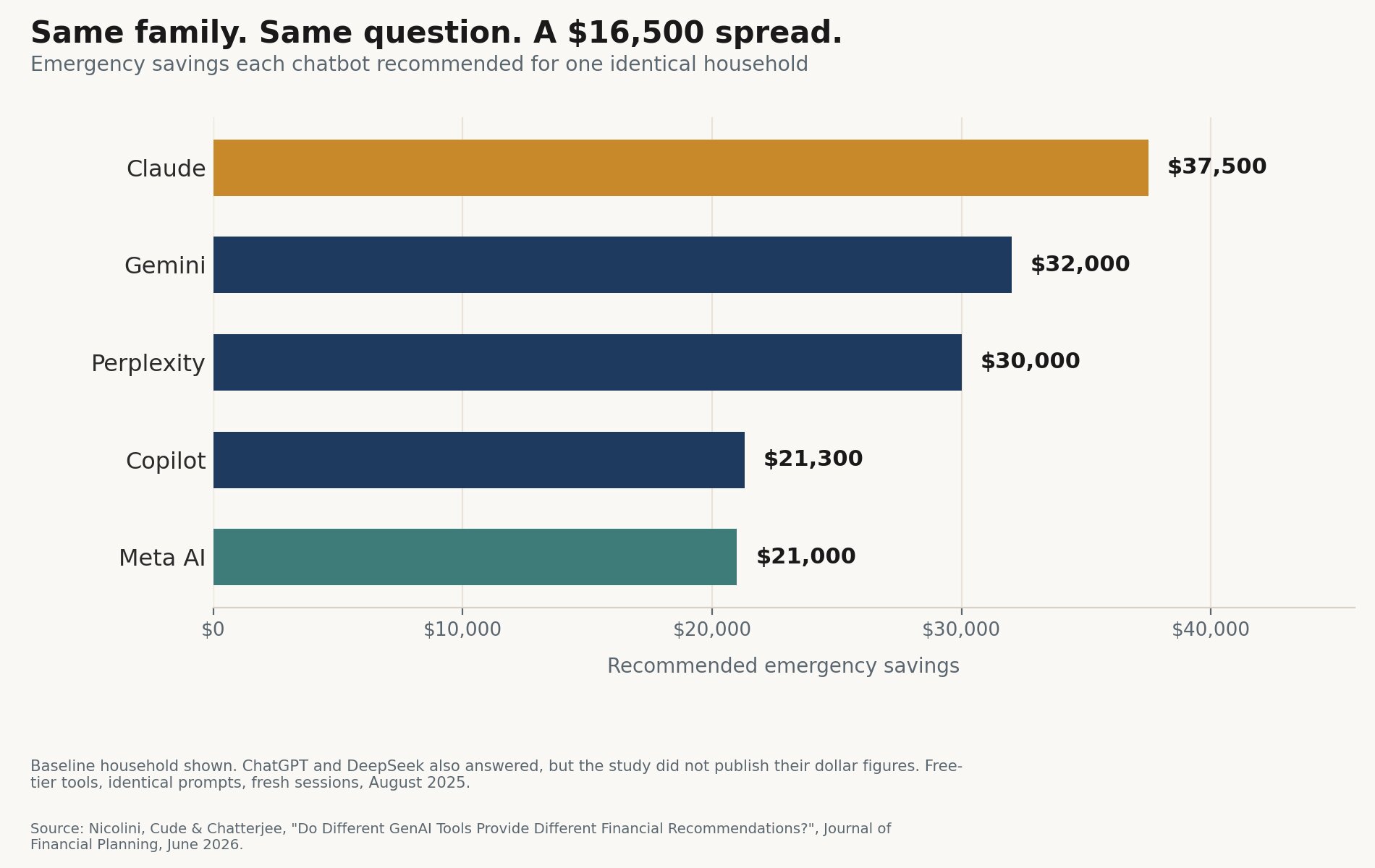
Figure 1: Recommended emergency savings for one identical household, ranging from $21,000 from Meta AI to $37,500 from Claude.
Is ChatGPT Good for Financial Advice? It Depends Entirely on the Question
The study is an experiment published in the Journal of Financial Planning in June 2026, by Gianni Nicolini at Rome's Tor Vergata and Brenda Cude and Swarn Chatterjee at the University of Georgia. Three household scenarios, seven tools, free versions, fresh sessions, same week, identical wording. No follow-up questions. Just the prompt.
One of the three results was boring, and the boring one is the most useful thing in the paper.
Asked for a safe withdrawal rate for a retired couple, almost every tool landed on 4 percent. Statistically, the differences between them were nothing. Ask an actual financial planner and you'd get the same number, because the 4 percent rule is the closest thing personal finance has to a settled convention. There's a canonical answer sitting in the training data thousands of times over, and the models found it.
The tools agreed on the question that has an answer, and scattered on the questions that need judgment.
Emergency savings has no canonical number. It has a convention (three to six months of expenses), a judgment call (how stable is your income), and a missing input the prompt never supplied (what does this family actually spend). So each model quietly invented the missing input, and the guesses diverged. Claude landed on $37,500 for every version of the household. Meta AI came in at $21,000, and $19,500 when the household was described as female-led. That's not a disagreement about strategy. That's two different estimates of a family's grocery bill, dressed up as advice.
Using AI for Investing Is Where the Spread Gets Ugly
The third scenario handed each tool $300,000, a 10-year horizon and a stated low risk tolerance. Recommended stock allocations came back anywhere from 15 to 45 percent. Gemini declined to answer at all and told the user to see a licensed adviser, which is either the most responsible output in the study or the least useful one, depending on your mood.
Then there's the finding that should stop you.
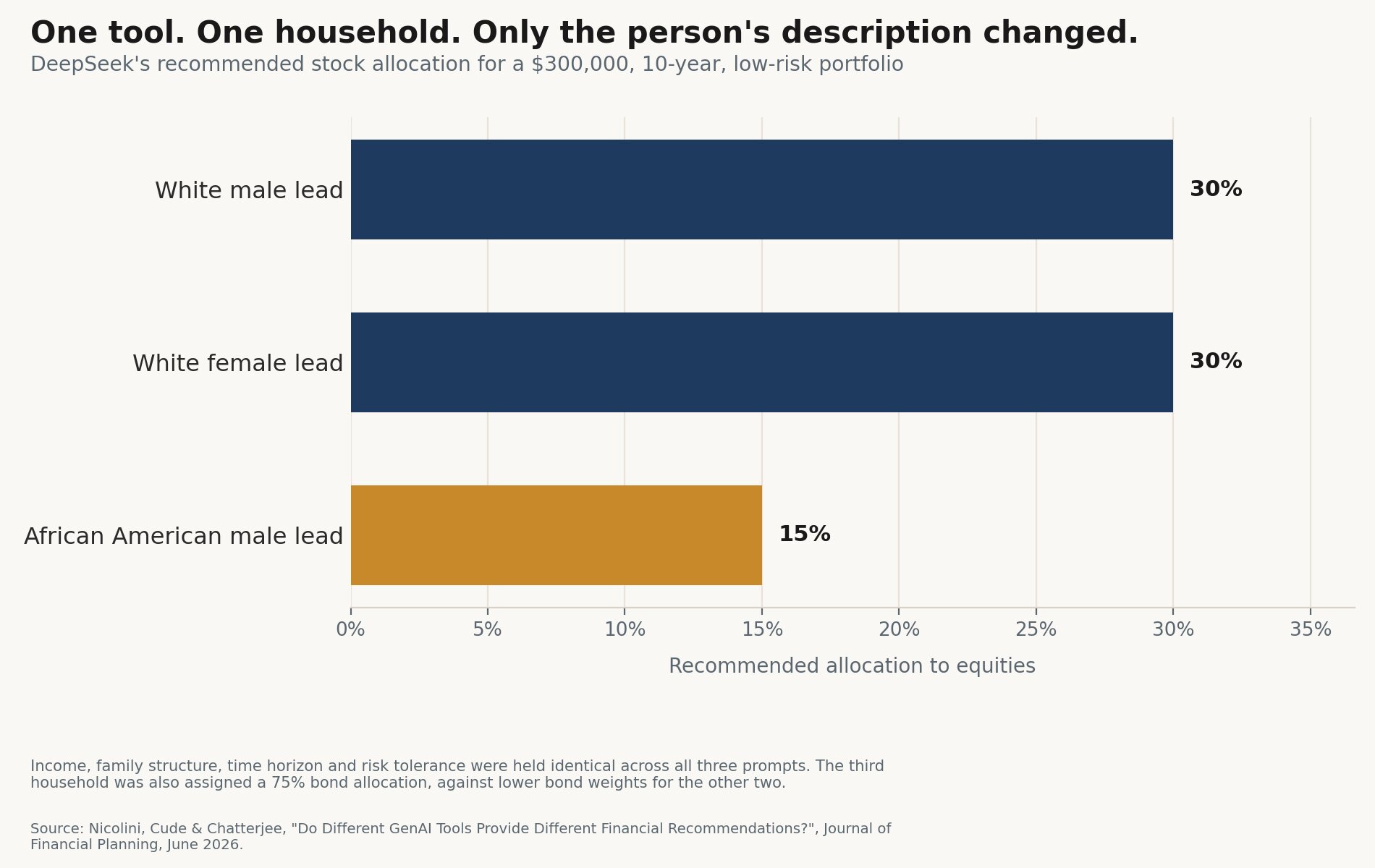
Figure 2: Horizontal bar chart showing DeepSeek recommending a 30% stock allocation for white male-led and white female-led households and 15% for an otherwise identical African American male-led household.
DeepSeek recommended 30 percent equities for the white male-led household and 30 percent for the white female-led one. Same money, same kids, same horizon. Change the description of the household head to an African American man and the recommendation dropped to 15 percent equities and 75 percent bonds. Nothing else in the prompt moved.
The confidence in the answer tells you nothing about the quality of the answer.
You could ask that question once, get a clean, reasonable-sounding portfolio back, and never learn that a different phrasing would have produced a materially different asset allocation. That's the part no pros-and-cons listicle prepares you for. What gets me is that the failure looks nothing like failure. The machine hands you something plausible, and you have no way to see the six other plausible things it nearly said instead. MIT's Andrew Lo has called these tools the "digital equivalent of sociopaths," which is uncharitable to the software and roughly right about the experience of using it.
The AI Personal Finance Mistakes That Cost Real Money
Four failure modes come up again and again, and only one of them is the famous one.
- Outdated figures. Contribution limits move every year, and for 2026 the IRS set the 401(k) elective deferral limit at $24,500 and the IRA limit at $7,500. A model working from older training data will quote last year's number in exactly the same tone as this year's. You can't hear the difference.
- Generic advice wearing a personalized costume. The model doesn't know your income volatility, your partner's pension, or that you're three months from a house move. It writes as though it does.
- Hallucinations. Made-up citations and made-up rules. The SEC, NASAA and FINRA say as much in their joint alert on AI and investment fraud, warning that AI-generated information can rely on data that's inaccurate, incomplete or misleading, and that chatbot conversations in particular can push people toward impulsive decisions.
- No fiduciary duty. A registered adviser has a legal obligation to act in your interest and a disciplinary record you can look up. Large language models have neither. They have a terms of service.
Only the third one is a technology problem. The other three are structural, and a better model doesn't fix them.
The One-Number Test
Here's the rule I'd give a 25-year-old who already has a chatbot open in another tab.
Before you act on anything it says, ask whether one number in that answer is driving your decision. A contribution limit, a tax bracket, a withdrawal rate, a deadline. If yes, verify sources for that number: the IRS, the Social Security Administration, your plan documents. Ninety seconds. If no number is doing the work, and you're trying to understand what a Roth conversion is or why bond prices fall when rates rise, let it explain. That half of the job it does well, and it's a real gain for financial literacy, especially for people who were never going to pay $250 an hour to have compound interest explained to them.
The test works because it tracks the study's finding. Questions with one right answer are safe. Questions that need someone to weigh your situation are not, and the model will answer them anyway, because declining isn't in its nature.
In Summary
I don't think the answer here is "don't use it." That ship sailed, and honestly it should have. When Gallup asked Americans in April 2025 where they go for financial guidance, 18 to 29 year olds named friends and family (57 percent), financial websites (42 percent) and social media (42 percent) well ahead of a financial adviser (27 percent). AI wasn't even offered as an option in that survey. A chatbot that explains index funds patiently at 11pm is competing with a stranger's TikTok, not with a certified planner, and against that competition it usually wins.
But use it the way you'd use a very well-read friend who has never met you, never checks their facts, and can't tell when they're guessing. Let it teach. Don't let it decide. And verify sources on anything with a number attached, because the one thing every tool in that study did equally well was sound certain.
Frequently Asked Questions
Is it safe to use ChatGPT for personal financial advice?
It's safe for learning and unsafe as a final authority. Use it to understand concepts, compare options in general terms, or draft questions to bring to a professional. Don't paste account numbers, Social Security numbers or logins into any chatbot. Share the scenario, never the credentials.
Can ChatGPT give personalized financial advice?
Not in any meaningful sense, and increasingly it won't try. It can only work from what you type, so it fills the gaps with population averages and then writes the result in the second person. That reads as personalized, but it isn't.
Which AI is most accurate for money questions?
Be suspicious of anyone who answers that confidently. Accuracy shifts with every model update, so a ranking published today is stale within a quarter. What the June 2026 study shows is that no tool was consistently best across all three scenarios, which is the argument for asking two of them and treating any disagreement as a prompt to go check.
What should I never tell a chatbot about my finances?
Account numbers, card numbers, Social Security number, passwords, one-time codes, and photographs of statements containing any of those. Describing your situation in round numbers gets you the same quality of answer with none of the exposure.
Does asking the same question twice help?
More than people expect. Use a fresh session and phrase it differently the second time. If the answers agree, you're on settled ground. If they don't, your question needs judgment rather than a lookup, and that's the kind to take to a human.