Investing
How Financial Literacy Quietly Closes the Wealth Gap (And Why Compound Interest Is the Real Equalizer)
Education, not financial advice. This page may contain affiliate links: if you buy through one, Alpha Investing Group may earn a commission at no extra cost to you. How we earn money · Editorial policy
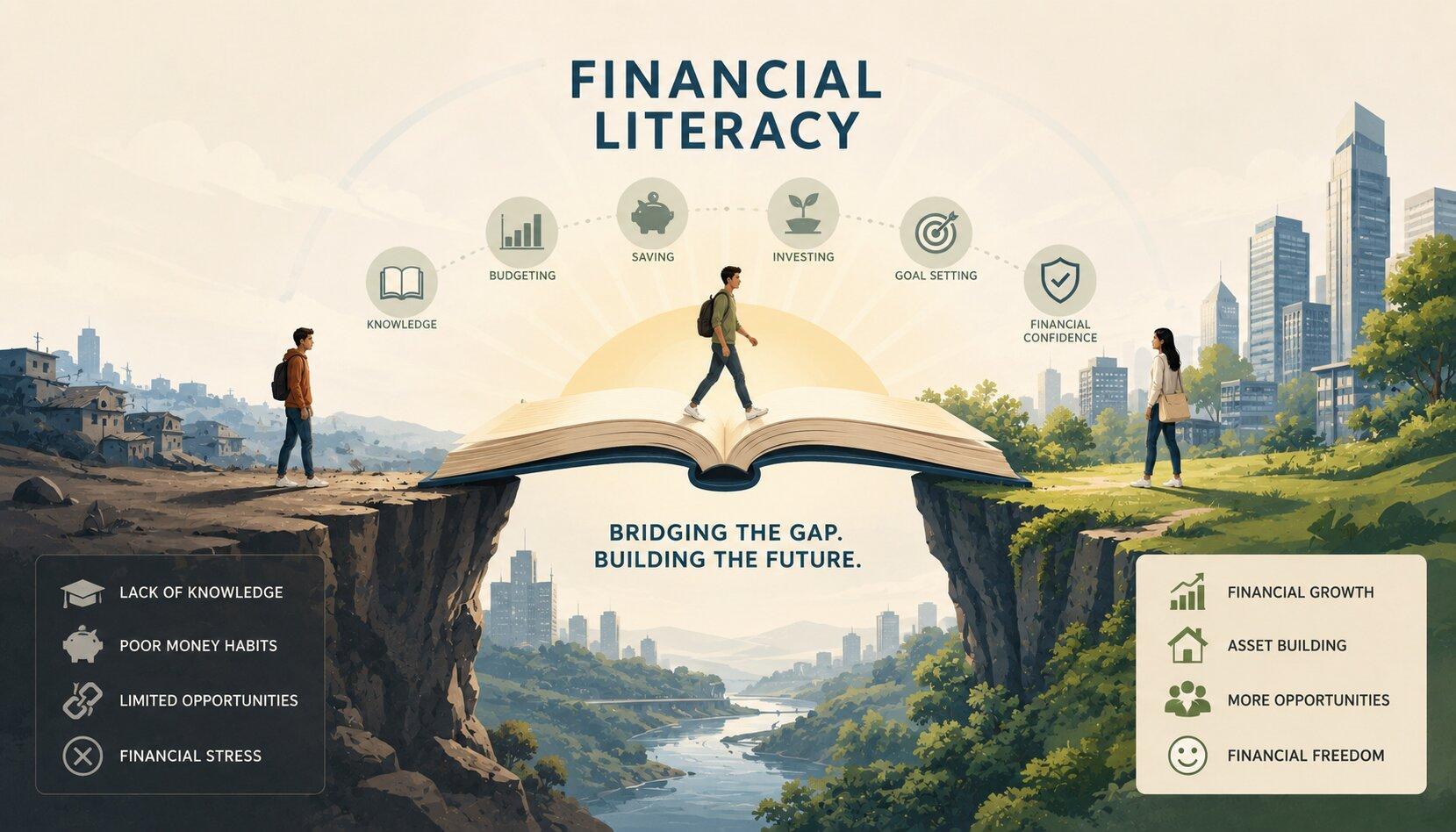
Most arguments about the financial literacy wealth gap end in the wrong place.
One side says financial education is the lever that closes inequality. The other says it can't possibly do that and the structural problems are too deep. Both sides are partly right and mostly missing the point. I've sat in this debate long enough to think the honest answer is calmer than either camp wants it to be.
So here's the version I actually believe.
Financial literacy is one of the largest measurable individual-level levers an ordinary person controls. It does not solve inequality on its own. But over a working lifetime, applied consistently, it quietly closes a real and surprisingly large slice of the wealth gap. The transmission belt is compound interest, which is one of the most apolitical forces in modern finance.
This post is about that mechanism, the data that backs it, and where the argument honestly breaks down.
The honest size of the wealth gap
The numbers are not subtle. The Federal Reserve's 2022 Survey of Consumer Finances notes on racial inequality show the typical White family held roughly six times the wealth of the typical Black family and five times the wealth of the typical Hispanic family. Those ratios narrowed slightly between 2019 and 2022, but the underlying gap is still measured in multiples, not percentages.
A century of policy sits underneath those numbers. As NEA Today's reporting on wealth gaps and financial literacy documents, restrictive covenants, redlining, and an unequally applied G.I. Bill blocked generational wealth from forming in millions of households. Black homeownership was 22% in 1900 versus 49% White. By 2020 it was 45% Black versus 74% White. Education access, including access to learning about money, lined up the same way.
I don't think you can stare at that history and argue financial literacy alone is going to fix it. That would be naive.
But it's just as naive to argue financial literacy doesn't move the needle at all.
The mechanism is compound interest, not willpower
This is the part the field keeps skipping. Almost no top-ranking piece on the financial literacy wealth gap walks through the math of how knowledge becomes wealth, so people end up arguing about the conclusion without examining the engine.
Two people earn the same $60,000 salary. One understands the employer match, the tax wrapper, and the long-run case for a low-cost index fund. They save 12% of salary in a 401(k) from age 30. The other saves 3%, mostly into a checking account, because nobody ever explained why that's not enough.
At a 7% real annual return over 35 years, the gap looks like this:
Two savers, same $60,000 salary, 35 years at 7% real
Saving 12% of the same $60,000 salary grows to about $995,000 after 35 years, four times the $249,000 of the saver putting away 3%.
- Saves 3% of salary
- Saves 12% of salary
Illustrative figures, not a forecast. Alpha Investing Group
Show the data
| Year | Saves 3% of salary | Saves 12% of salary |
|---|---|---|
| 1 | $1,800 | $7,200 |
| 2 | $3,726 | $14,904 |
| 3 | $5,787 | $23,147 |
| 4 | $7,992 | $31,968 |
| 5 | $10,351 | $41,405 |
| 6 | $12,876 | $51,504 |
| 7 | $15,577 | $62,309 |
| 8 | $18,468 | $73,871 |
| 9 | $21,560 | $86,242 |
| 10 | $24,870 | $99,478 |
| 11 | $28,410 | $113,642 |
| 12 | $32,199 | $128,797 |
| 13 | $36,253 | $145,013 |
| 14 | $40,591 | $162,364 |
| 15 | $45,232 | $180,929 |
| 16 | $50,198 | $200,794 |
| 17 | $55,512 | $222,050 |
| 18 | $61,198 | $244,793 |
| 19 | $67,282 | $269,129 |
| 20 | $73,792 | $295,168 |
| 21 | $80,757 | $323,029 |
| 22 | $88,210 | $352,841 |
| 23 | $96,185 | $384,740 |
| 24 | $104,718 | $418,872 |
| 25 | $113,848 | $455,393 |
| 26 | $123,618 | $494,471 |
| 27 | $134,071 | $536,284 |
| 28 | $145,256 | $581,023 |
| 29 | $157,224 | $628,895 |
| 30 | $170,029 | $680,118 |
| 31 | $183,731 | $734,926 |
| 32 | $198,393 | $793,571 |
| 33 | $214,080 | $856,321 |
| 34 | $230,866 | $923,463 |
| 35 | $248,826 | $995,306 |
The 12% saver finishes with around $995,000. The 3% saver finishes near $249,000. Same salary, same starting age, same market. A roughly $746,000 spread, built almost entirely from one person knowing things the other person didn't.
That is compound interest doing what compound interest does. It rewards the person who put more in earlier and let it sit. It does not ask who the person is.
The data: financial knowledge explains more than people think
This is where the field undersells the case. The most cited estimate comes from Lusardi, Michaud and Mitchell, whose working paper on optimal financial knowledge and wealth inequality attributes between 30% and 40% of US wealth inequality to differences in financial knowledge accumulated over a lifetime. That is a remarkable number. It says roughly a third of the spread you see at retirement is a literacy story, not a wage story.
The catch is that most adults are operating with weak baseline knowledge. The 2025 TIAA Institute-GFLEC Personal Finance Index, which is the canonical FINRA-adjacent US measurement, finds adults answer only 49% of basic questions correctly. That number has barely moved since 2017. Gen Z scores 38%. Women score nearly ten points lower than men on the index. Comprehending risk is the weakest area across every demographic.
So the country is sitting on a measurable lever that's roughly a third of the wealth inequality problem, and the average score on the lever is a coin flip.
This is what I mean by "quietly." The retirement savings gap doesn't get closed by a viral video or a policy announcement. It gets closed by individual people learning a small set of boring things and acting on them for decades.
Steel-manning the other side
The strongest version of the structural-only view comes from Duke's William Darity and economist Tim Kaiser, both quoted in Fortune's "The financial literacy gap doesn't exist". Their argument: low- and middle-income kids score about the same on financial knowledge tests as higher-income kids, so the wealth gap isn't a knowledge gap, it's a resources gap. As Darity puts it, financial education without resources is a recipe without ingredients.
He's half right.
A teenager with no income can't act on knowledge. A first-generation worker without an employer match can't reach for the match. Kaiser's meta-analysis of 70-plus financial education studies shows the effect is real but conditional on having resources to act on. The structural ceiling matters.
But the wealth gap isn't just a "did you start with capital" question. It's also a "what did you do with the income you earned over 40 years" question. That second question is where the literacy lever lives. And it's also where behavioral finance lives, because most of the gap doesn't come from the math. It comes from defaults, defaults set in adolescence by exposure or no exposure to the basics.
Financial inclusion, in other words, is the floor. Financial literacy is the multiplier above the floor.
What this means for the individual reader
If you're reading this and earning a paycheck, the lever in your hands is unusually large for how invisible it is. A small list of moves does most of the work toward wealth accumulation:
- Capture every dollar of your employer match before paying down anything that isn't above roughly 7% interest.
- Choose a low-cost broad-market index fund as the default holding in any tax-advantaged account.
- Automate contributions and stop touching the number for at least a decade.
- Learn the difference between marginal and effective tax brackets, because Roth versus Traditional turns on it.
- Teach the same five sentences to one other person who didn't grow up hearing them.
None of those are advice. They are descriptions of what compounding rewards. The reason this works as a quiet equalizer is that the rules apply to the saver, not the family they were born into.
So what's the strong opinion
Financial literacy will not, on its own, undo a century of structural inequality. Anyone who tells you otherwise is selling something.
But within the resources a person actually has, financial knowledge is the single largest individual-level lever for closing their own slice of the wealth gap. About a third of where you'll land at retirement is decided by what you know, not what you earn. The mechanism is compound interest. Compound interest does not check who's pulling on it.
The version I'll defend isn't "literacy fixes everything" and it isn't "literacy fixes nothing." It's that the largest lever you actually control happens to be a slightly boring one, and almost nobody talks about it that way.
In summary
- The racial wealth gap is real and big: roughly six-to-one White-to-Black and five-to-one White-to-Hispanic in the 2022 Federal Reserve data.
- About 30 to 40 percent of US wealth inequality is attributable to differences in financial knowledge over a lifetime, per Lusardi, Michaud and Mitchell.
- US adults score 49% on the P-Fin Index, the same as in 2017. The lever is sitting on the floor.
- The mechanism is compound interest. Two people on a $60,000 salary, one saving 3% and one saving 12% for 35 years at 7% real, end up with $249,000 versus $995,000.
- Financial literacy doesn't fix structural inequality. It is the largest individual-level lever above the structural floor.