Personal Finance
Roth or Traditional 401(k)? The Tax-Bracket Question That Settles It
Education, not financial advice. This page may contain affiliate links: if you buy through one, Alpha Investing Group may earn a commission at no extra cost to you. How we earn money · Editorial policy
Your first 401(k) enrollment form asks you to guess your own future: Roth or Traditional 401(k)?
It asks as if you're supposed to already know what tax bracket you'll be in thirty years from now. Most people freeze, pick whatever their coworker picked, and never think about it again. That's not a great plan, but it's also not the disaster it feels like in the moment, because the decision comes down to one question you can actually answer.
What's ahead, in order:
- The single question that decides Roth versus Traditional for almost everyone
- How a 401(k) contribution changes your tax bill, with the mechanic most explainers skip
- A worked example using real 2026 numbers on a $75,000 salary
- The edge cases: high earners, a big raise on the horizon, and what changed for 2026
- The five-minute action to take today and never revisit unless your income changes a lot
Why this trips up new earners more than it should
You just started your first job with a 401(k). Or maybe you've had one for a few years and never actually chose, so you're sitting in whatever your employer defaulted you into.
Either way, the anxiety is the same. It feels like a permanent, high-stakes call. It isn't. You can change your contribution split going forward at almost any time, and the money you've already put in stays put in whichever bucket it landed in. This is a decision you can revisit, not a decision you're locked into for life.
The traditional-or-roth-401k-for-20-somethings version of this question has one extra wrinkle worth naming up front: you're probably in one of the lowest tax brackets you'll ever be in. That fact alone tilts the math for a lot of people under 30, and we'll come back to it. If this 401(k) decision is your first real brush with retirement tax planning, it's worth zooming out afterward to set the rest of your financial goals for your 20s, since the account choice matters less than the habit of contributing at all.
The one question that actually decides it
Every guide on this topic eventually says some version of "it depends on your tax bracket now versus later" and then stops, as if that's obvious. It isn't, so let's make it concrete.
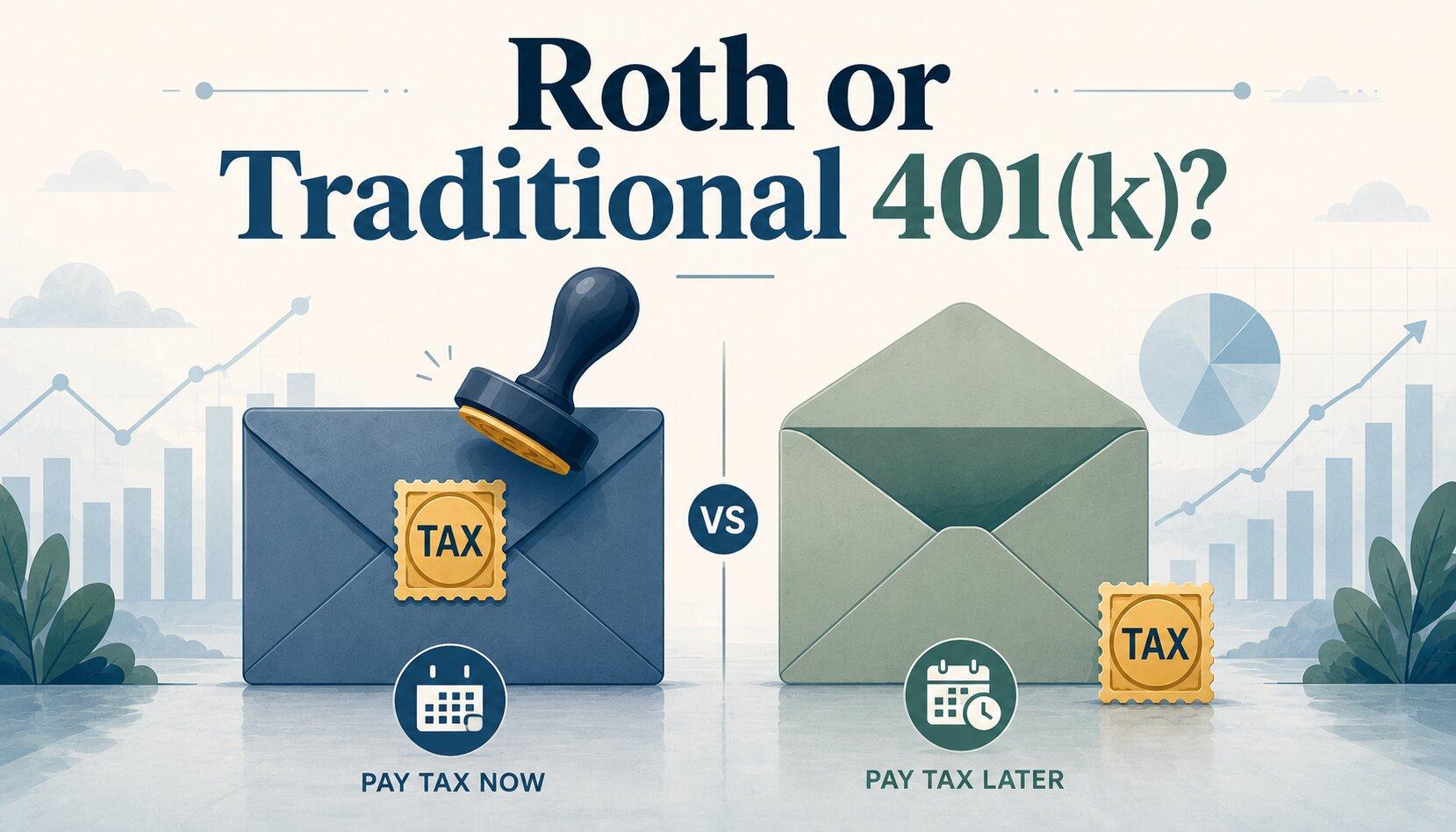
Choose Traditional if you expect a lower marginal tax bracket in retirement than you're in today. You get the tax break now, while your rate is higher, and pay tax later at what should be a cheaper rate.
Choose Roth if you expect an equal or higher marginal tax bracket in retirement. You pay tax now, while your rate is known and (for most young earners) relatively low, and every dollar of growth comes out tax-free later.
That's the whole rule. Everything else in this guide is either helping you estimate which side of that line you fall on, or handling the situations where the line gets blurry.
One clarification that trips people up: this is about your marginal rate, the rate on your next dollar of income, not your average rate across your whole paycheck. Marginal rate is what a contribution actually saves or costs you, because contributions come off the top of your income first.
How a 401(k) contribution actually changes your tax bill
Most retirement tax planning explainers skip the actual mechanic, which is a shame, because it's the reason this decision has real dollars attached to it and isn't just abstract preference.
A Traditional 401(k) contribution is a pre-tax contribution. It comes out of your paycheck before income tax is calculated, which lowers your taxable income for the year. Because the federal system is layered (you only pay each bracket's rate on the income that falls inside that bracket), pulling your taxable income down can knock some of it out of a higher bracket entirely. The IRS's own explanation of how tax brackets work makes this point plainly: your whole income never gets taxed at your top rate, only the slice that falls in that bracket.
A Roth 401(k) contribution is an after-tax contribution. The money you put in has already been taxed at your current marginal rate, so it doesn't touch this year's tax bill at all. What you're buying instead is a future where that money, and everything it grows into, comes out with zero federal tax owed, as long as you clear the IRS's five-year rule: the account has to be open at least five years and you have to be 59 and a half before a withdrawal counts as fully tax-free.
Neither one is a loophole. You're choosing when the IRS gets paid, not whether. It's the same logic behind most tax-efficient investing decisions: the goal usually isn't paying less tax overall, it's paying it at the cheapest point in your timeline.
The worked example: a $75,000 salary through 2026's actual brackets
Real numbers make this concrete, and that's the gap every competing guide on this topic leaves open.
Say you're single, earning $75,000 a year, filing for the 2026 tax year. Start with the IRS's 2026 standard deduction of $16,100 for single filers. That brings your taxable income to $58,900, which lands you in the 22% marginal bracket under the official 2026 rate schedule (22% applies above $50,400 for single filers).
Now say you contribute $10,000 to your 401(k) this year, roughly 13% of your salary, which is a realistic number once you count an employer match.
If it's Traditional, that $10,000 comes off your taxable income before tax is calculated. Some of it falls in the 22% bracket and some spills down into the cheaper 12% bracket, since $10,000 pulls your taxable income from $58,900 down to $48,900, crossing the $50,400 line. Blended, that $10,000 contribution saves you about $2,050 in federal income tax this year: $1,870 on the $8,500 that would have been taxed at 22%, and $180 on the $1,500 that would have been taxed at 12%. Your paycheck only shrinks by about $7,950 to fund a $10,000 retirement contribution.
If it's Roth, you've already paid income tax on that $10,000 through your regular paycheck withholding. Your take-home pay drops by the full $10,000, because there's no deduction to claim. What you get in exchange is that the entire $10,000, plus every dollar it grows into over the next several decades, comes out tax-free in retirement.
Same $10,000 contribution, different hit to this year's paycheck
A $10,000 Traditional 401(k) contribution cuts this year's take-home pay by about $7,950, because it saves about $2,050 in federal income tax; a Roth contribution cuts it by the full $10,000.
Illustrative figures, not a forecast. Source: IRS 2026 standard deduction and tax brackets (assumptions) · Alpha Investing Group
Show the data
| Contribution type | Reduction in take-home pay this year |
|---|---|
| Traditional 401(k) ($10,000 pre-tax) | $7,950 |
| Roth 401(k) ($10,000 after-tax) | $10,000 |
Same contribution, same account, two very different hits to this year's paycheck. That's the trade-off in dollars, not theory. If you expect to retire in a lower bracket than 22%, the math favors Traditional. If you expect 22% or higher, especially plausible if you're 26 and still climbing your income curve, Roth is the stronger case.
First, capture the match. It isn't actually part of this decision
Before any of the above matters, make sure you're contributing enough to get your full employer match. That part isn't a tax-bracket question at all, it's free money, and skipping it to optimize Roth-versus-Traditional is like turning down a raise to save on the calculation. I've seen people spend an hour agonizing over the tax-bracket question and about five seconds confirming they're getting the full match. That's backwards.
Almost nobody explains this detail clearly: your employer's matching contribution always lands in a Traditional, pre-tax account, no matter which type you personally choose. If you elect Roth for your own contributions, you'll end up holding both account types automatically, since the employer's money legally can't follow you into the Roth bucket. That's not a downside. It just means you're getting a small amount of tax diversification for free, whether you asked for it or not.
Where the simple rule bends
The marginal-bracket-now-versus-later rule handles most cases. A few situations deserve a second look before you commit.
First, you're expecting a significant raise or promotion soon. If you know you're jumping brackets in the next year or two, weight your decision toward what your bracket will be after that jump, not your bracket today.
Second, you're married and filing jointly. The math is the same rule, but run it against your household's combined marginal bracket, not your individual salary in isolation. A spouse's income can push your combined bracket meaningfully higher or lower than your solo number would suggest.
Third, you're 50 or older and earn more than $150,000. Starting in 2026, a rule from the SECURE 2.0 Act requires catch-up contributions for higher earners in this bracket to go into a Roth account specifically, no exceptions. Charles Schwab's guide to Roth 401(k) rules confirms the new mandate and notes that plans without a Roth option simply can't offer catch-up contributions to these employees at all. If this is you, the decision on your catch-up dollars has already been made for you.
Fourth, you genuinely have no idea what your future bracket will be. This is a completely reasonable place to land, especially early in your career. The honest answer isn't paralysis, it's tax diversification: split your contributions between both account types. You'll have flexibility later to pull from whichever bucket makes the most sense in any given retirement year, rather than betting everything on one guess made decades in advance.
The five-minute action
Translate all of that into five minutes of action.
- Check your match first. Confirm you're contributing at least enough to get 100% of your employer's match, regardless of account type.
- Estimate your current marginal bracket. Use your salary minus the standard deduction against the 2026 IRS bracket table, the same way we did above.
- Make your honest best guess about retirement. If you expect lower, lean Traditional. If you expect the same or higher, lean Roth. If you genuinely don't know, split it.
- Set your contribution percentage in your plan portal and automate it. Same as any other financial habit, the goal is to stop thinking about it, not to re-litigate it every paycheck.
- Revisit only when something big changes. A large raise, a marriage, a new tax bracket structure. Not every January.
That's it. This isn't a decision that deserves the anxiety it usually gets. Once your 401(k) contribution is automated, the same "set it and stop touching it" approach applies to picking the fund inside the account, which is where the best investment strategy for beginners usually points people next.
In summary
If you only take one thing from this guide, take the rule: compare your marginal tax bracket today against your best estimate of your marginal tax bracket in retirement.
- Traditional wins if you expect a lower bracket later. You get the tax break now, while your rate is higher.
- Roth wins if you expect an equal or higher bracket later. You lock in today's rate, and everything grows tax-free after that.
- On a $75,000 salary in 2026, a $10,000 Traditional contribution costs about $7,950 of take-home pay versus the full $10,000 for Roth, because of how contributions interact with your marginal bracket.
- Capture the full employer match first. It's automatically pre-tax no matter what you choose, so it isn't part of the Roth-versus-Traditional call at all.
- If you're unsure, split your contributions between both. That's tax diversification, not indecision.
Pick a lane, automate it, and get back to your life. The bigger financial win here isn't optimizing the split down to the last percentage point, it's making sure you're contributing consistently at all.
This article is educational and not personalized tax or investment advice. Tax laws are subject to change. Consult a tax professional about your specific situation before making retirement account decisions.