Personal Finance
The Lifestyle Creep That Quietly Eats Your Next Raise (And the 50% Rule That Stops It)
This page may contain some affiliate links. This means that, at no additional cost to you, Alpha Investing Group will earn a commission if you click through and make a purchase. Learn more.
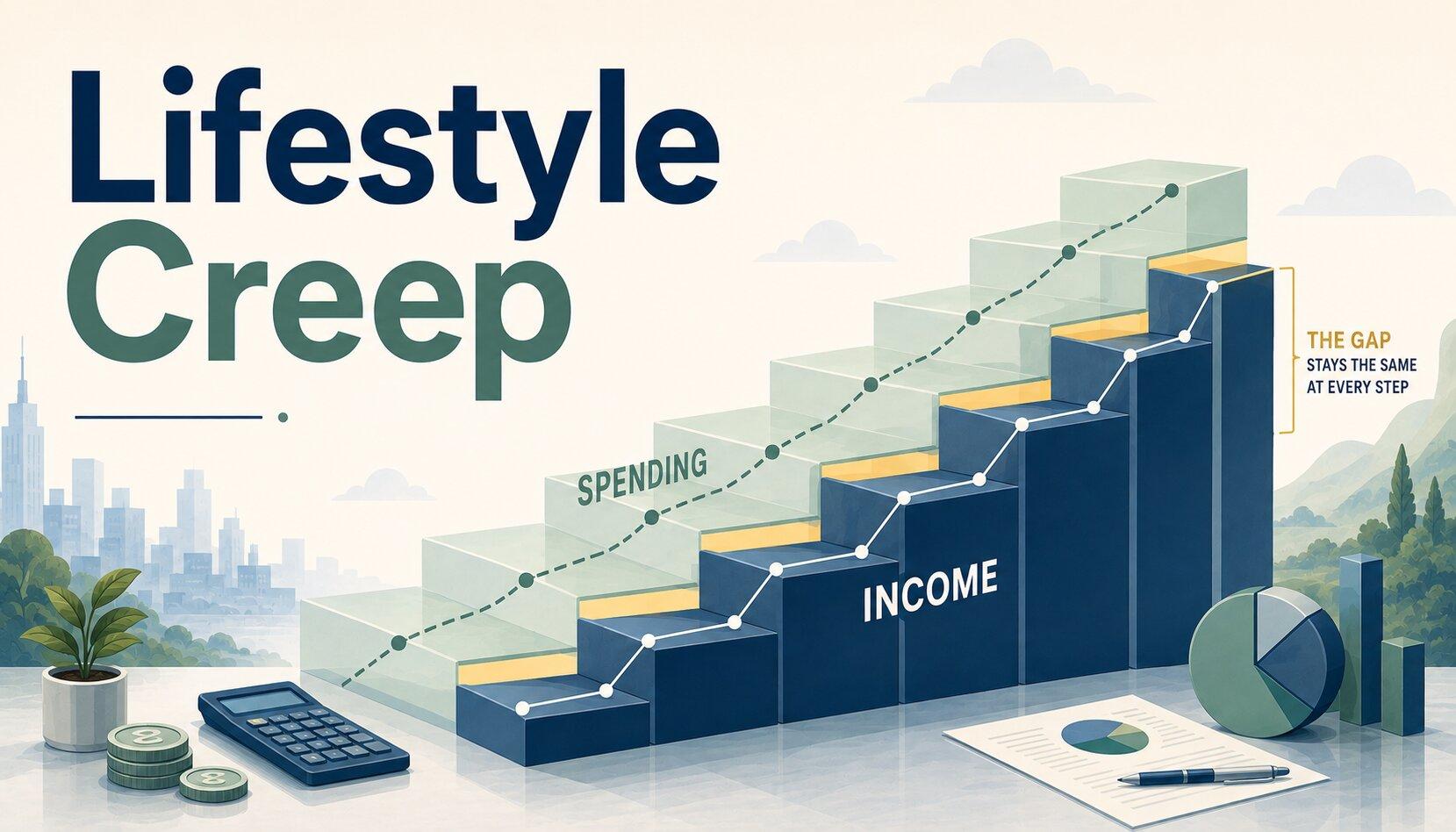
A raise feels like a turning point. Then a few months pass, the bigger paycheck starts to feel completely normal, and your savings look about the same as they did before. That quiet gap between earning more and keeping more has a name. It's called lifestyle creep, and it's the reason a lot of people don't actually get richer as they get paid more.
Here's the part nobody warns you about. Lifestyle creep isn't a willpower problem. Your brain is built to reset its idea of "normal" every time your spending goes up, so the newer car and the nicer apartment stop feeling special within weeks. Which means the fix can't be willpower either. It has to be a rule that grabs part of every raise before you ever get the chance to spend it.
The savings rate barely moves, even when paychecks grow
Look at the national numbers and the pattern is hard to miss. The Bureau of Economic Analysis data on personal saving shows the US savings rate sat at just 3.7% at the start of 2026, down from roughly 5% a year earlier. People earned more in nominal terms across that stretch. The savings rate didn't follow the paychecks up.
That disconnect is lifestyle creep at the scale of a whole country.
It shows up the same way in one household. You get a 10% bump, you tell yourself you'll finally start investing seriously, and instead the raise dissolves into a better lease, more takeout, and a couple of subscriptions you forgot you signed up for. None of it feels reckless. That's exactly the problem. Fidelity's explainer on lifestyle creep makes a fair point that some upgrades are healthy and earned. The danger is the upgrades that happen by default, without a single decision behind them.
Why your brain spends the raise before you decide to
There's a real mechanism under this, and understanding it takes the shame out of the whole thing. Psychologists call it hedonic adaptation. The joy from a purchase or a pay bump fades fast, pulling your happiness back down toward where it started and leaving you reaching for the next upgrade.
Researchers studying hedonic adaptation have shown how quickly that reset happens. The nicer apartment thrills you for a month. By month three it's just where you live. I've felt this with everything from a new phone to a bigger place, and the fade is always faster than I expect.
So the raise gets spent before you consciously decide to spend it. Your baseline for "normal" moves up to meet your new take-home pay, and the gap you meant to save never appears. Fighting that with discipline alone is exhausting, which is why the daily habits that quietly secure a financial future tend to be automatic ones, not heroic ones. Willpower runs out. A standing instruction doesn't.
The 50% rule: what to do with a raise before it reaches your take-home pay
Here's the rule I'd give almost anyone asking how much of a raise to save: keep half, save half.
When a raise lands, split it down the middle before the money ever hits your checking account. Fifty percent goes to your future through savings and investments. The other fifty percent is yours to enjoy, with no guilt and no spreadsheet. You still feel the raise. You just don't let all of it evaporate into a new normal.
The 50% is the number that makes this work, and there's a reason it isn't 100%. A rule that asks you to bank every dollar of every raise fails, because it denies the whole point of earning more. You're allowed to live a little better. The 50% split lets your lifestyle rise at half the speed of your income, which is slow enough that your savings rate climbs every single time you get paid more.
One detail matters. Do the split on your raise after taxes, not the headline number. A $5,000 gross raise might be closer to $3,500 in real take-home pay once withholding is done. Save half of what actually reaches you, so the target is honest and you can hit it every time.
How to automate the savings half so willpower never enters the picture
The rule only works if the saving half happens without you. Here's the order I'd set it up in.
- Bump your payroll deduction first. The moment your raise is confirmed, increase your 401(k) contribution so a chunk of the saving half is gone before it's ever paid to you. You can put a lot here. The 2026 401(k) contribution limit rose to $24,500, with an extra $8,000 catch-up once you're 50, so most people have plenty of room. If there's an employer match you're not fully capturing, this is where the raise should go first.
- Set a standing transfer for the rest. Whatever part of the saving half isn't going through payroll, move it with automated savings. A standing order from checking to a brokerage or high-yield account, dated for the day after payday, does the job. Money you never see is money you never adapt to.
- Leave the spending half completely alone. No tracking, no budget spreadsheet for that portion. That freedom is what keeps the system alive for years instead of weeks.
This is the same principle behind a good system for breaking the paycheck-to-paycheck cycle: decide once, automate, and let the default do the work. The reason automation beats budgeting here is simple. A budget fights hedonic adaptation every month. A payroll deduction wins the fight one time and stays won.
What skipping this once actually costs
It's tempting to treat a single raise as too small to matter. The math disagrees.
Take that $3,500 after-tax raise. The 50% rule sends $1,750 a year into investments and leaves the other $1,750 for your life. Invested steadily at an illustrative 7% annual return, that $1,750 a year could grow past $160,000 over 30 years, from about $52,500 of actual contributions.
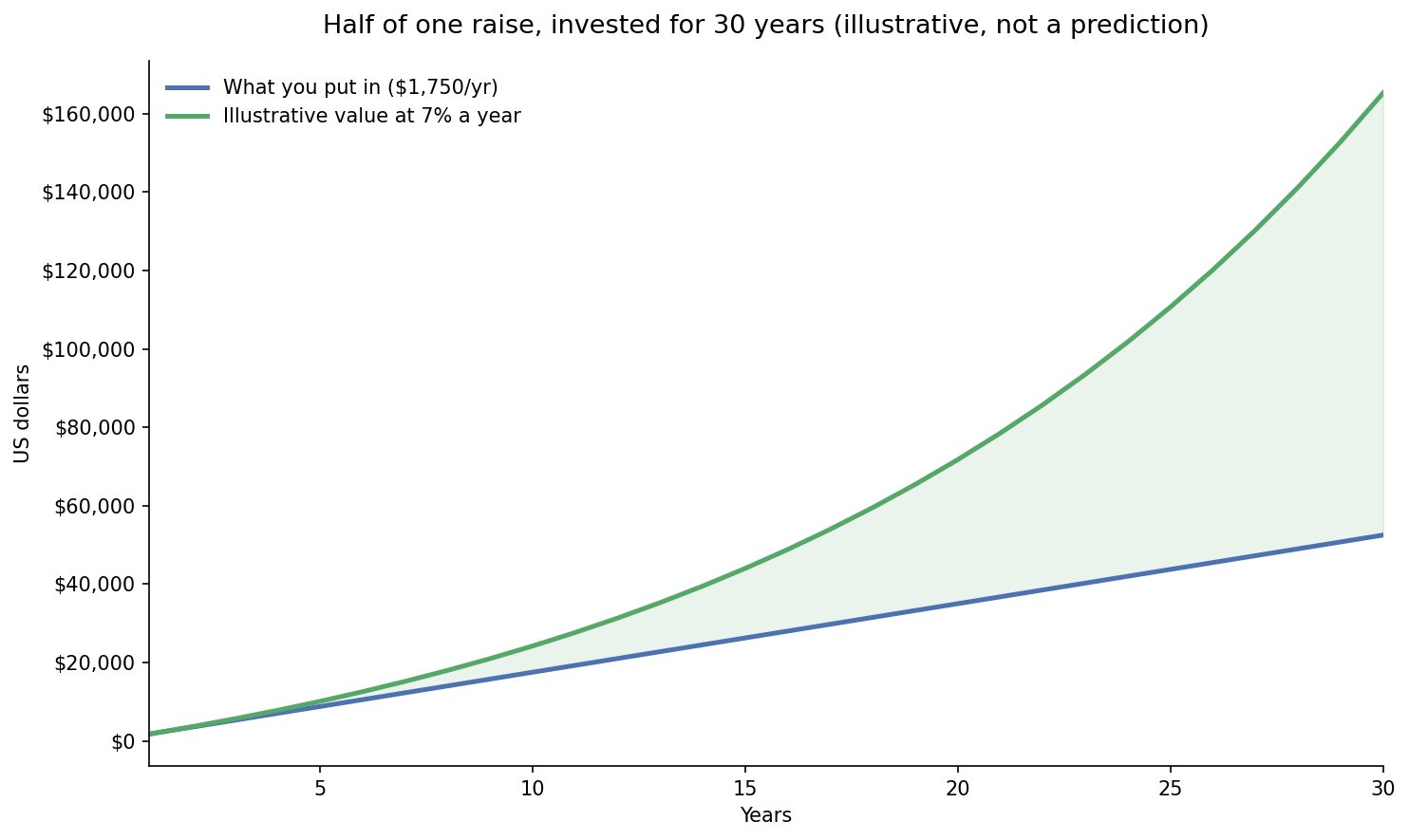
Figure 1: Comparing money contributed versus illustrative investment value over 30 years, showing $52,500 of contributions growing to roughly $165,000 at a hypothetical 7% annual return.
To be clear, that 7% is an illustration, not a promise. Real returns vary year to year and can be negative, and no one can tell you what the market will do. The point isn't the exact figure. It's the shape of the gap between what you put in and what compounding can do with it, and the fact that this is the value of one raise you decided not to fully spend. Now imagine doing it with every raise for a decade. That's the quiet compounding cost of skipping the rule, and it's why financial discipline ends up controlling your financial life far more than income does.
In summary
Lifestyle creep isn't a character flaw. It's the default setting of a brain that adapts to whatever you give it. You don't beat a default with effort. You beat it by changing the default.
Keep half of every raise for your life. Automate the other half into savings before it reaches your take-home pay. Do that once per raise and you get to enjoy earning more without watching the whole raise disappear. That's the entire game, and it's boring on purpose, because the boring version is the one that still works in ten years.
Frequently asked questions
Is lifestyle creep always bad?
No. Spending more as you earn more is normal and often healthy, and you worked for the ability to live better. The problem is lifestyle creep that happens by default, with no decision behind it, so your spending rises exactly as fast as your income and your savings rate never moves. The 50% rule keeps the upgrades while capping their speed.
How much of a raise should you save?
Half is the number I'd start with. It's aggressive enough that your savings rate rises with every raise, and gentle enough that you still feel the reward, which is what keeps you doing it. If you have big goals or a late start, save more. Just avoid 100%, since a rule that denies you any benefit from earning more rarely survives contact with real life.
Should I save the raise before or after taxes?
After. Base the 50% split on your actual raise after taxes, not the gross figure your offer letter shows. A raise on paper is always bigger than the take-home pay that reaches your account, so splitting the real number keeps the target realistic and repeatable.
What if I have debt instead of savings goals?
Then the "save half" instruction becomes "put half toward your financial position," and high-interest debt comes first. Paying down a card charging 22% is a guaranteed return you can't get in the market. Send the saving half at your debt until the expensive balances are gone, then redirect it to investing. The habit is identical. Only the destination changes.