Investing
What Is Financial Literacy? What Americans Get Wrong in 2026 (and How to Fix Yours)
Education, not financial advice. This page may contain affiliate links: if you buy through one, Alpha Investing Group may earn a commission at no extra cost to you. How we earn money · Editorial policy
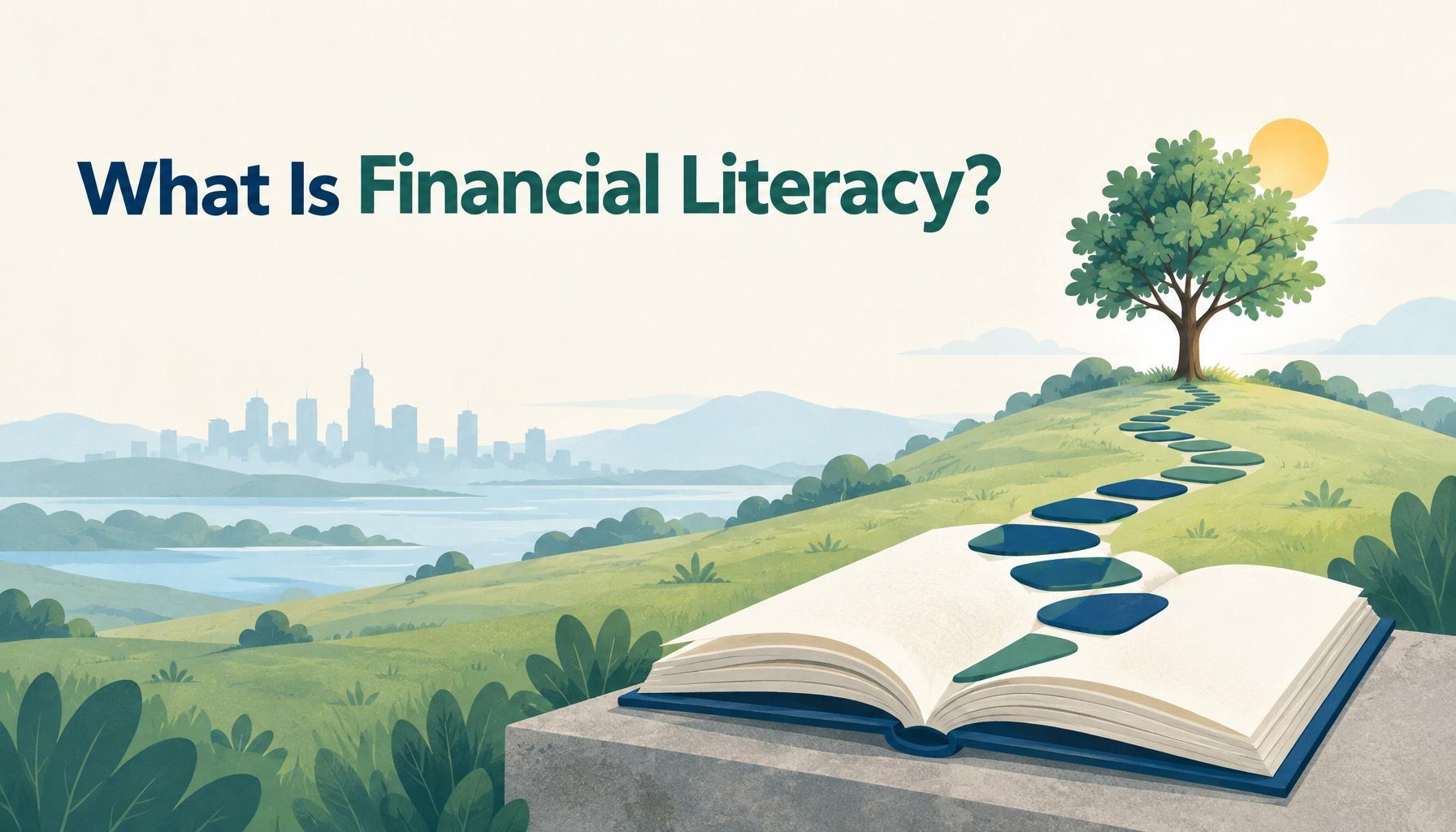
So, what is financial literacy? It's knowing enough about how money works to make a sound decision on your own, without a salesperson or an app making it for you.
That sounds easy enough. Then you see the data. In January 2026, a national survey asked 3,602 American adults 28 everyday money questions, and the average person got fewer than half right. Young adults did worse than anyone, which matters because your twenties are when the habits that decide the next forty years get set.
Here's the hopeful part. Most people miss the same handful of ideas, and you can learn those in a few weekends.
What is financial literacy? A plain-English definition
Financial literacy is the knowledge and judgment you need to manage everyday money decisions well. The OECD, which runs the biggest international survey on the subject, defines it as a mix of awareness, knowledge, skills, attitudes and behaviors. Behaviors is the word people skip. Knowing what compound interest is counts for little if you still carry a credit card balance every month.
It also isn't about being good at math or picking winning stocks. Two people can make opposite choices and both be financially literate. One keeps a house deposit in a high-yield savings account. Another puts long-term money in an index fund. If each understands the product, their goal and the risk they're taking, both are making informed decisions.
The TIAA Institute and the Global Financial Literacy Excellence Center (GFLEC) break it into eight areas that come up in normal life:
- Earning, meaning what drives your pay and why your take-home pay is smaller than your salary
- Consuming, which is budgeting and keeping spending under control
- Saving, including what inflation quietly does to cash
- Investing, and how risk and return are tied together
- Borrowing and managing debt, or how interest rates and loan terms change what you repay
- Insuring, which covers the types of coverage and how insurance actually pays out
- Comprehending risk, the skill of thinking clearly about outcomes that aren't certain
- Go-to information sources, or telling good advice from a sales pitch
If that list looks long, here's the shorter version. Financial literacy is understanding how money comes in, how it leaves, how it grows and what can go wrong.
How financially literate are Americans in 2026?
Not very. And it's getting worse.
The 2026 TIAA Institute-GFLEC Personal Finance Index, published in June 2026, found that US adults answered 47% of its 28 questions correctly. That's the lowest score in the index's ten-year history, and the figure has never topped 52%. A quarter of adults got seven or fewer questions right.
Gen Z, born between 1997 and 2007, averaged 38%. Millennials averaged 46%. And 37% of Gen Z landed in the "very low" group, the largest slice of their generation.
Other surveys tell the same story. In the FINRA Foundation's 2024 National Financial Capability Study, only 27% of more than 25,500 adults answered at least five of seven basic questions correctly, according to the FINRA Foundation's state-by-state knowledge findings. This isn't only an American problem either. Across the 39 countries in the OECD/INFE 2023 survey of adult financial literacy, only 34% of adults reached the minimum target score, and just 42% could answer a compound interest question. (The US didn't take part in that one.)
The financial literacy topics people get wrong most
The weak spots aren't random. Comprehending risk is the weakest area for adults overall, at 36% correct in 2026. For Gen Z, the weakest area is insuring, at just 25%. Borrowing is the strongest area at every age. The report's authors suspect that's because people learn about debt by having it. That's a painful way to learn.
Share of financial literacy questions answered correctly, by topic: Gen Z vs millennials (2026)
Gen Z trails millennials in every topic, and the gap is widest on insurance, where Gen Z got just 25% right.
- Gen Z
- Millennials (Gen Y)
Source: TIAA Institute-GFLEC Personal Finance Index 2026, Figure 5 (survey fielded January 2026, published June 2026) · Alpha Investing Group
Show the data
| Topic | Gen Z | Millennials (Gen Y) |
|---|---|---|
| Borrowing and managing debt | 47% | 57% |
| Saving | 45% | 54% |
| Consuming and budgeting | 43% | 47% |
| Go-to information sources | 42% | 47% |
| Earning | 37% | 46% |
| Investing | 35% | 43% |
| Comprehending risk | 33% | 36% |
| Insuring | 25% | 37% |
The actual questions make the gaps easier to feel. Here are four from the 2026 survey's eight-question short version, with the share of adults who got each one right:
- A $1,000 loan charges 20% a year, compounded annually, and you make no payments. How long until you owe double? Only 40% knew it takes less than five years. (It's about four.)
- Your savings earn 2% while prices rise 3%. Can you buy more or less at the end of the year? 48% knew the answer is less.
- What insurance does a healthy, single 25-year-old most likely need soonest? Only 27% picked disability insurance, which replaces your paycheck if you can't work. It was the lowest score on the quiz.
- Is a 5% chance at $200 worth more than a 0.01% chance at $90,000? 46% knew the first pays more on average ($10 versus $9).
None of these need advanced math. They need a feel for how interest and probability behave, which most of us were never taught. Guessing wrong on them is also where the money leaks out. So does believing the personal finance myths most of us pick up without checking.
Why is financial literacy important?
Because the people who score lowest pay for it every month, in money and in stress.
The P-Fin Index compares adults with very low and very high financial literacy. Those at the bottom are four times as likely to struggle to make ends meet. They're three times as likely to be financially fragile, meaning they couldn't come up with $2,000 within a month. They're four times as likely to lack one month of savings outside a retirement account. They also spend about 13 hours a week thinking about money problems, against about four hours for the most literate group.
That last number gets me. Thirteen hours a week is a part-time job made of worry.
The credit card example
Here's how a small gap in knowledge turns into real dollars. The average interest rate on credit card accounts that pay interest was 22.15% in the second quarter of 2026, according to the Federal Reserve's G.19 consumer credit release.
Say you put a $1,000 laptop on a card at that rate. If you pay it off when the bill arrives, it costs $1,000. If you pay $30 a month, it takes 53 months and costs about $1,567, with $567 of that in interest. Doubling the payment to $60 clears it in 21 months for about $206 of interest.
Paying off $1,000 on a credit card at 22.15% APR: $30 vs $60 a month
Illustrative example: at the Fed's Q2 2026 average card rate, $30 a month takes 53 months and about $567 in interest, while $60 a month takes 21 months and about $206.
- Paying $30 a month
- Paying $60 a month
Illustrative figures, not a forecast. Source: Alpha Investing Group calculation using the Federal Reserve G.19 average rate on credit card accounts assessed interest, Q2 2026 (22.15%), compounded monthly, no new purchases · Alpha Investing Group
Show the data
| Month | Paying $30 a month | Paying $60 a month |
|---|---|---|
| 0 | $1,000 | $1,000 |
| 1 | $988 | $958 |
| 2 | $977 | $916 |
| 3 | $965 | $873 |
| 4 | $953 | $829 |
| 5 | $940 | $784 |
| 6 | $927 | $739 |
| 7 | $915 | $693 |
| 8 | $901 | $645 |
| 9 | $888 | $597 |
| 10 | $875 | $548 |
| 11 | $861 | $498 |
| 12 | $847 | $448 |
| 13 | $832 | $396 |
| 14 | $818 | $343 |
| 15 | $803 | $290 |
| 16 | $787 | $235 |
| 17 | $772 | $179 |
| 18 | $756 | $123 |
| 19 | $740 | $65 |
| 20 | $724 | $6 |
| 21 | $707 | $0 |
| 22 | $690 | $0 |
| 23 | $673 | $0 |
| 24 | $655 | $0 |
| 25 | $638 | $0 |
| 26 | $619 | $0 |
| 27 | $601 | $0 |
| 28 | $582 | $0 |
| 29 | $563 | $0 |
| 30 | $543 | $0 |
| 31 | $523 | $0 |
| 32 | $503 | $0 |
| 33 | $482 | $0 |
| 34 | $461 | $0 |
| 35 | $439 | $0 |
| 36 | $417 | $0 |
| 37 | $395 | $0 |
| 38 | $372 | $0 |
| 39 | $349 | $0 |
| 40 | $326 | $0 |
| 41 | $302 | $0 |
| 42 | $277 | $0 |
| 43 | $252 | $0 |
| 44 | $227 | $0 |
| 45 | $201 | $0 |
| 46 | $175 | $0 |
| 47 | $148 | $0 |
| 48 | $121 | $0 |
| 49 | $93 | $0 |
| 50 | $65 | $0 |
| 51 | $36 | $0 |
| 52 | $7 | $0 |
| 53 | $0 | $0 |
The card company doesn't hide any of this. Your statement shows how long minimum payments will take. Most people just never look at that box.
More of the decisions are now yours
Your grandparents' generation often had a pension that paid a set amount for life, and the employer carried the investment risk. Most young workers now get a 401(k) or nothing. You decide whether to join, how much to put in and what to invest in. If those choices go badly, nobody makes up the difference.
Savings buffers are also getting thinner. The FINRA Foundation's 2024 National Financial Capability Study found that only 46% of adults had three months of expenses set aside for emergencies, down from 53% in 2021. If you're in the other 54%, our emergency fund guide walks through building one on a normal paycheck.
Add all those individual gaps up across a country and they become a measurable share of wealth inequality. I dig into that argument, and where it breaks down, in how financial literacy closes the wealth gap.
Does financial education actually work?
Mostly, yes. A meta-analysis of 76 randomized trials by Tim Kaiser, Annamaria Lusardi, Lukas Menkhoff and Carly Urban, covering more than 160,000 people, found that financial education improves both knowledge and later behavior. The effects were similar in size to education programs in other subjects.
The honest caveat is that knowledge doesn't fix everything. A course can't raise your wages or cut your rent. What it can do is stop avoidable mistakes from stacking on top of the hard parts you can't control.
Schools are catching up, slowly. As of October 5, 2026, 30 states guarantee a standalone personal finance course before high school graduation, according to Next Gen Personal Finance's live state dashboard. Only 11 of those have fully put it in place. The other 19 are still rolling it out. If you graduated before that, you probably have to teach yourself.
How to improve your financial literacy
Start small. A free quiz and a couple of good books will take you further than an expensive course.
- Get a baseline. Take our free financial literacy test and note which topics trip you up. Guessing your weak spots is less useful than seeing them.
- Start with your weakest area, not your favorite one. For most people that's risk or insurance, the two topics nobody brings up at dinner.
- Learn the order of money decisions. Knowing whether to save, invest or pay off debt first prevents a lot of expensive mistakes. The financial order of operations lays out a sequence you can follow.
- Read one or two good books. A weekend with one of the best personal finance books covers more ground than months of scrolling money videos.
- Check where your advice comes from. Ask whether the person or tool earns money from what they're recommending. That includes AI chatbots, which 19% of adults have now used for money questions, per the 2026 P-Fin survey.
Then talk about money with people you trust. It's awkward the first few times. I still think it's the quickest way to find out what you don't know, because friends ask the questions you'd never think to look up.
The short version
- Financial literacy is the knowledge and judgment to make everyday money decisions on your own, across earning, spending, saving, investing, borrowing, insurance and risk.
- US adults answered 47% of the P-Fin Index questions correctly in 2026, a ten-year low. Gen Z averaged 38%.
- Risk and insurance are the weakest areas. Borrowing is the strongest, often learned the hard way.
- Low literacy shows up as thin savings, expensive debt and hours of weekly money worry.
- Financial education works, and the fastest place to start is finding out where you stand.
Financial literacy won't make you rich on its own. What it does is make the expensive mistakes rarer, and over forty years of paychecks, avoiding them is most of the job.