Investing
What Is an ETF? A Plain-English Guide for Beginners
Education, not financial advice. This page may contain affiliate links: if you buy through one, Alpha Investing Group may earn a commission at no extra cost to you. How we earn money · Editorial policy
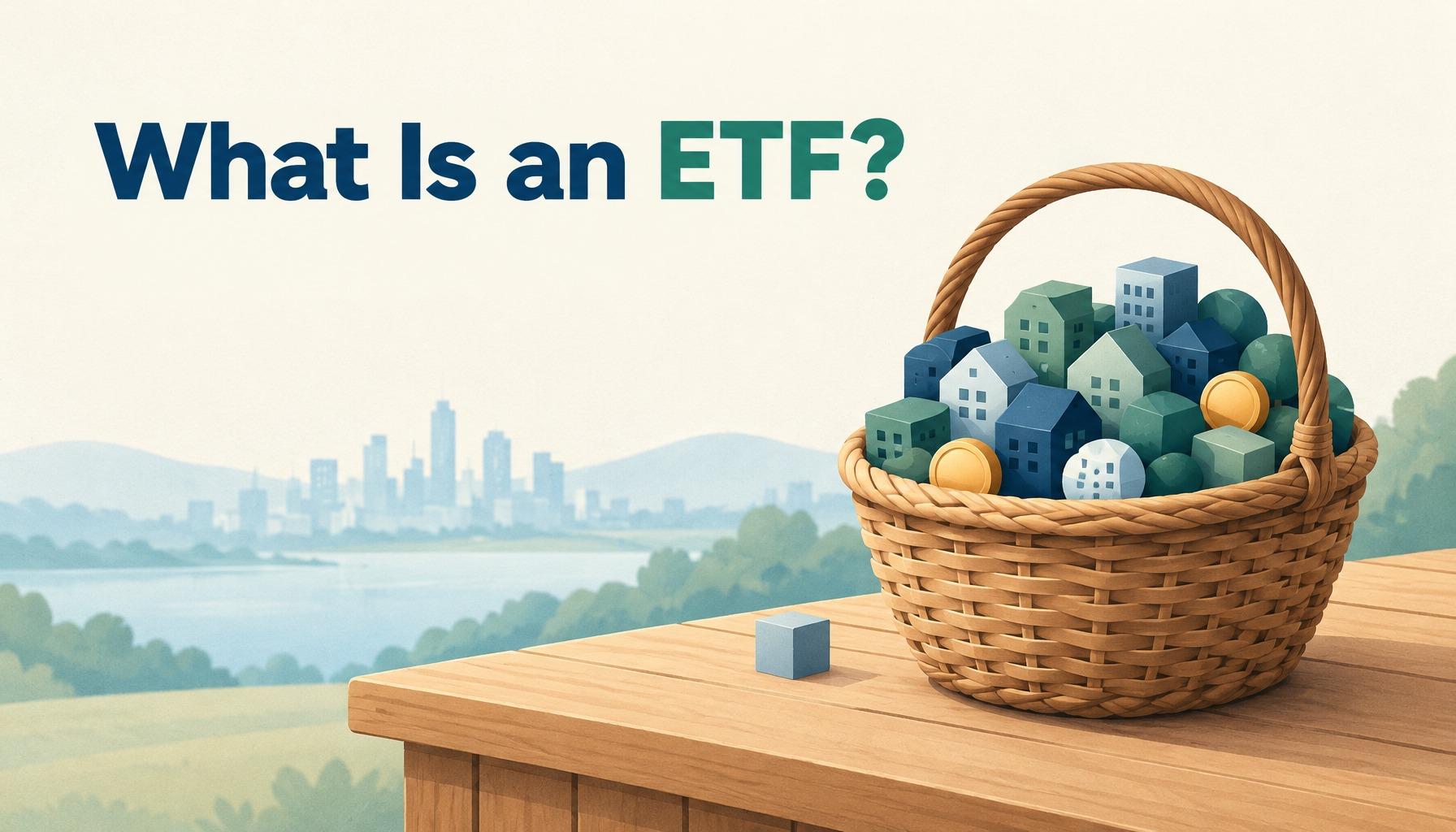
What is an ETF? An exchange-traded fund (ETF) is a fund that pools investors' money into a basket of investments, often hundreds of stocks or bonds, and trades on a stock exchange like a single stock. Buy one share and you own a small slice of everything in the basket. People use ETFs because they're a cheap, simple way to spread their money across many companies in one trade.
They've become enormous. US ETFs held $13.4 trillion at the end of 2025, and 89% of that sat in index ETFs, according to the Investment Company Institute's 2026 report on fund fees.
Any fund named below is only an example of its category, not a recommendation, and this is general education rather than personal advice.
What an ETF is, in plain English
Think of a pre-packed grocery basket. Instead of walking the aisles and picking up 500 items one at a time, you grab one basket that already holds all of them in set amounts. The label tells you what's inside. The basket's price rises and falls with the prices of the things in it.
An ETF works the same way. An S&P 500 ETF holds the roughly 500 companies in that index. As one example of the category, a single share of the iShares Core S&P 500 ETF (IVV) gave you a slice of 504 holdings as of October 7, 2026, according to the fund's own page.
Two details trip up a lot of beginners:
- The ETF is just the wrapper. What you own is whatever the basket holds, so a stock ETF behaves like stocks and a bond ETF behaves like bonds.
- Most ETF money follows an index, but not every ETF does. The SEC's investor bulletin on ETFs explains that an index ETF tries to match its index's returns, while an actively managed ETF lets a manager choose what to buy.
Index ETFs are where most beginners start, and the long-run record explains why. Over the 20 years to June 30, 2026, 92.6% of actively managed US large-cap stock funds trailed the S&P 500, according to the SPIVA U.S. scorecard from S&P Dow Jones Indices.
Matching the market cheaply has beaten trying to outsmart it, most of the time. Our guide to passive investing covers that idea in more depth.
How an ETF works: market price, NAV and creation
You buy and sell ETF shares from other investors through a brokerage account, any time the market is open, and the price moves during the day like a stock's.
Every ETF also has a net asset value (NAV), which is what everything in the basket is worth per share. The fund calculates it every business day. Market price and NAV are usually close but rarely identical, and paying a little more than NAV is called a premium, a little less a discount.
What keeps them close is a process called creation and redemption. Large brokerage firms, called authorized participants, can hand the fund a basket of the underlying stocks in exchange for new ETF shares, or hand shares back for the stocks. If the ETF's price drifts above the value of its holdings, they create shares and sell them, which pulls the price back down. If it drifts below, they do the reverse.
In grocery terms, if the basket sold for more than its contents, a wholesaler would pack more baskets and sell them until the gap closed.
That same swap is why ETFs tend to be tax-efficient. Because many ETFs trade securities in kind rather than for cash, the SEC bulletin says they "typically have fewer capital gain distributions than mutual funds." In a regular brokerage account, that can mean a smaller tax bill while you hold the fund.
The main types of ETFs
Most ETFs fall into a handful of groups, and beginners mostly run into these:
- Broad stock index ETFs track a whole market, such as the S&P 500 or the total US stock market. They're the plainest version of the idea.
- Bond ETFs hold government or corporate bonds and pass on the interest. A total bond market ETF can hold thousands of bonds in one share.
- Sector ETFs focus on one industry, like technology or healthcare. They're less diversified, because a single industry can fall hard on its own.
- International ETFs hold companies outside the US, in developed markets, emerging markets or the whole world. Whether you need one is a real debate, and we cover it in whole-world or US-only index funds.
- Dividend ETFs pick companies that pay larger or steadier dividends. They're still stock funds, so they still fall in a crash.
There are also commodity funds that track gold or oil, and currency funds. Some of these aren't registered investment companies at all, which means fewer investor protections.
The ETFs beginners should be wary of
Leveraged and inverse ETFs are built for traders, not buy-and-hold investors. A leveraged ETF tries to deliver two or three times an index's daily move, and an inverse ETF tries to deliver the opposite.
Most reset every day, so over weeks or months the results can drift a long way from what the name suggests. The SEC's bulletin on leveraged and inverse ETFs gives a real case where an index gained about 8% over four months while a fund aiming for three times its daily return fell 53%.
Very niche or thinly traded ETFs are the other trap. Few buyers means a wider gap between the buying and selling price, and small funds also close. When one does, you sell before trading stops or get your share of the cash later. Either way, you've been pushed into a sale you didn't choose.
ETF vs mutual fund vs index fund vs stock
The most common mix-up I see is treating "ETF" and "index fund" as opposites. They aren't. "ETF" describes how a fund trades, and "index fund" describes what it invests in.
The SEC's comparison of mutual funds and ETFs notes that both can follow a passive or an active strategy, and that passively managed funds are typically called index funds. An S&P 500 ETF is an index fund that happens to trade on an exchange.
| ETF | Mutual fund | Index fund | Individual stock | |
|---|---|---|---|---|
| What it is | A fund that trades on an exchange | A fund you buy from the fund company | Any fund, ETF or mutual fund, that tracks an index | A share of one company |
| When you can trade | Any time the market is open | Once a day, at that day's NAV | Depends on whether it's an ETF or a mutual fund | Any time the market is open |
| Diversified? | Usually, depending on what it tracks | Usually | Yes, across its index | No |
| Yearly fee | Low for broad index ETFs | Higher for actively managed funds | Usually the lowest | None |
| Least you can start with | One share, or less with fractional shares | A minimum set by each fund | Depends on the wrapper | One share, or less with fractional shares |
The same SEC page adds that inside a 401(k) or IRA there's no tax difference between an ETF and a mutual fund. For how index funds are built and weighted, see our index investing 101 guide.
What ETFs cost in 2026
The main cost is the expense ratio, a yearly fee taken as a percentage of your balance. You never get a bill. It comes out of the fund's value quietly, every day.
The ICI's latest research on fund fees gives these 2025 asset-weighted averages, which is what investors actually paid:
- 0.14% for index stock ETFs
- 0.05% for index stock mutual funds
- 0.64% for actively managed stock mutual funds
Yes, index mutual funds averaged cheaper than index ETFs. The wrapper matters less than the fund inside it.
The biggest broad-market ETFs sit below the average, and IVV, for example, charges 0.03%, or $3 a year on $10,000. But the simple average across every index stock ETF on sale was 0.45%, so plenty charge far more. Cheap isn't automatic. You have to check.
Two smaller costs sit on top of the fee:
- The bid-ask spread is the gap between what buyers will pay and what sellers will accept, and the SEC calls it "a hidden cost to investors." Heavily traded ETFs usually have tighter spreads, and a fund's website lists its median spread.
- Commissions have mostly disappeared. FINRA's guide to online trading notes that many online platforms offer commission-free trading, though other fees can still apply. Many also sell fractional shares, so you can put in $50 instead of the roughly $780 one IVV share cost on October 7, 2026. FINRA's guide to fractional shares warns that availability varies by broker and that fractional shares generally can't be moved to another firm.
Worked example: what a fee costs over 30 years
Small percentages look harmless. Over decades, they aren't.
Say you invest $200 a month for 30 years, $72,000 in total, and the investments earn 7% a year before fees. That return is illustrative, not a forecast. Here's what each fee would cost you compared with paying no fee at all, using the same math as our expense ratio calculator:
What the fee costs on $200 a month for 30 years at 7%
Illustrative only: on the same $72,000 of deposits, a 0.64% fee costs about $27,500 compared with no fee, roughly 20 times what a 0.03% fee costs.
Illustrative figures, not a forecast. Source: Alpha Investing Group expense ratio calculator. Assumes $200 a month for 30 years and a 7% yearly return before fees. Expense ratios: iShares IVV fund page (0.03%) and ICI 2025 asset-weighted averages (0.14%, 0.64%). · Alpha Investing Group
Show the data
| Expense ratio | Cost of fees after 30 years |
|---|---|
| 0.03% (low-cost broad index ETF) | $1,379 |
| 0.14% (average index stock ETF) | $6,353 |
| 0.64% (average active stock mutual fund) | $27,460 |
You'd end up with about $232,500 at 0.03% (a low-cost broad index ETF), $227,500 at 0.14% (the average index stock ETF) and $206,400 at 0.64% (the average active stock mutual fund). The gap between the cheapest and the priciest is about $26,000, more than a third of everything you put in. The deposits and the market were identical in all three. Only the fee was different.
Your real return will differ, and some years it'll be negative. The fee is the one number you know in advance, which is why I'd look at it before anything else. To see what actual market history did instead of a steady 7%, the index investing calculator replays the S&P 500 and Nasdaq for the dates you pick.
How to buy your first ETF
- Open an account. A regular brokerage account works for any goal, and an IRA adds tax breaks for retirement money. If your employer matches 401(k) contributions, many people take the match first.
- Pick a broad, low-cost fund. A total US market or S&P 500 ETF is the plain starting point many beginners use, and our roundup of low-cost index funds compares the options.
- Check the expense ratio and the fund's size. Look for a fee near the low end of the range above, and skip tiny funds that might close.
- Place the order. A limit order sets the most you'll pay per share, which protects you from a bad price on a jumpy day. With fractional shares you can order by dollar amount instead.
- Automate it. A monthly transfer and automatic purchase means you buy the same amount whether markets are up or down. Our guide to investing $100 a month shows how small amounts add up.
Risks and honest caveats
An ETF is a useful tool, and it can still lose you money. A few caveats are worth knowing before you buy:
- It's only as diversified as its index. An S&P 500 ETF holds about 500 companies, but they're all large US companies, and the biggest handful make up a big chunk of the fund.
- It can lose value. If the stocks in the basket fall, the ETF falls with them, sometimes a lot and for years.
- Trading often defeats the point. Most long-term investors are better off ignoring the ability to trade all day, since every trade costs a spread and maybe a tax bill.
- The name doesn't tell you everything. A fund called "dividend" or "innovation" can be far more concentrated than it sounds, so read what it holds and what it charges.
Honestly, picking an ETF is the easy part. Leaving it alone when the market drops is much harder.
The short version
- An ETF is a basket of investments that trades like a single stock, and its price stays close to the value of what it holds.
- ETFs and index funds aren't opposites. Most ETF money sits in index ETFs.
- Fees compound. In the illustrative example, 0.03% versus 0.64% costs about $26,000 on $200 a month over 30 years.
- A broad, cheap fund, bought automatically and held for years, is the simple version that works for most beginners.